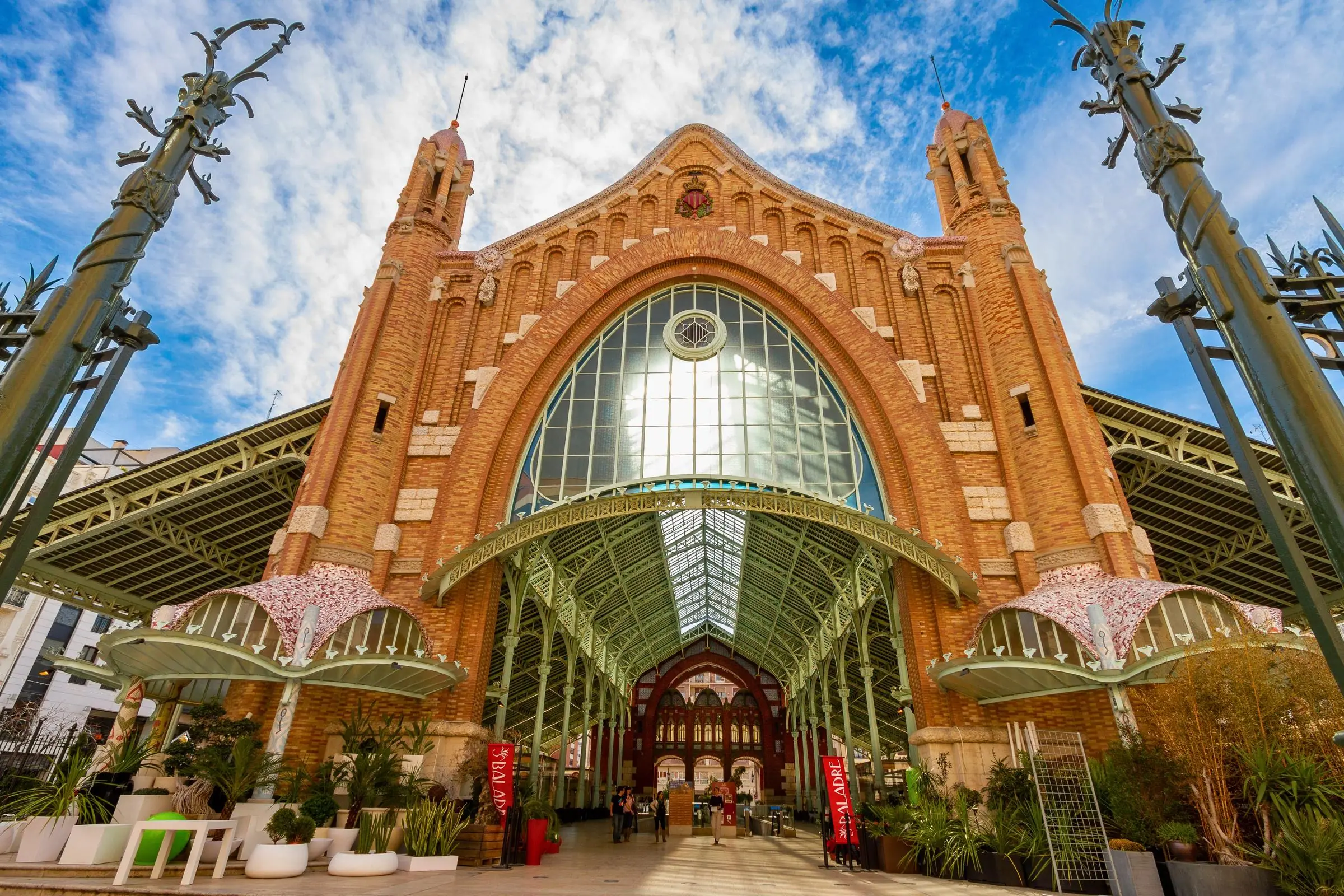
Occupying a full city block in the upscale L’Eixample neighborhood, Mercado de Colón (Colón Market) is one of Valencia’s most striking architectural achievements. Designed by Francisco Mora Berenguer and completed in 1916, this former fresh produce market was meticulously restored in the early 2000s. Today, it doesn’t sell raw fish or hanging jamón; instead, it serves as a high-end gastronomic hub filled with cafes, tapas bars, and craft beer taprooms.
If you are looking for a place to sit with a glass of Turia beer, admire Gaudí-esque architecture, and watch stylish locals go about their day, this is where you go.
Know Before You Go: Mercado de Colón is a gourmet food hall, not a traditional grocery market. If you are looking to buy raw ingredients, fresh seafood, or bulk spices, you should head to the Central Market instead.
Mercado de Colón vs. Central Market
Visitors often confuse Valencia’s two famous markets. While both are architectural marvels built in the early 20th century, they serve entirely different purposes today.
The Central Market (Mercado Central) is raw, chaotic, and functional. It is a working grocery market where chefs and locals buy their daily produce, meats, and seafood before 3:00 PM. The vibe is loud, fast-paced, and heavily focused on commerce.
Mercado de Colón, by contrast, is a social destination. It is open late into the night. The stalls have been replaced by sit-down restaurants, open-air terraces, and boutique gourmet shops. You come here to eat a prepared meal, sip horchata, or meet friends for evening drinks. If you want to dive deeper into the city’s culinary scene, booking a guided food tour that covers both the raw markets and the finished tapas is highly recommended, or you can browse other Valencia wine and food tasting experiences to round out your itinerary.
Keep Planning: Read our full breakdown of the Central Market to plan your morning grocery run.
5 Highlights of Mercado de Colón
The market is split across two levels: the airy, open ground floor (mostly cafes and terraces) and the sunken lower level (restaurants and specialized bars). Here is what you should focus on.
1. The Grand Exposed Brick and Iron Arches
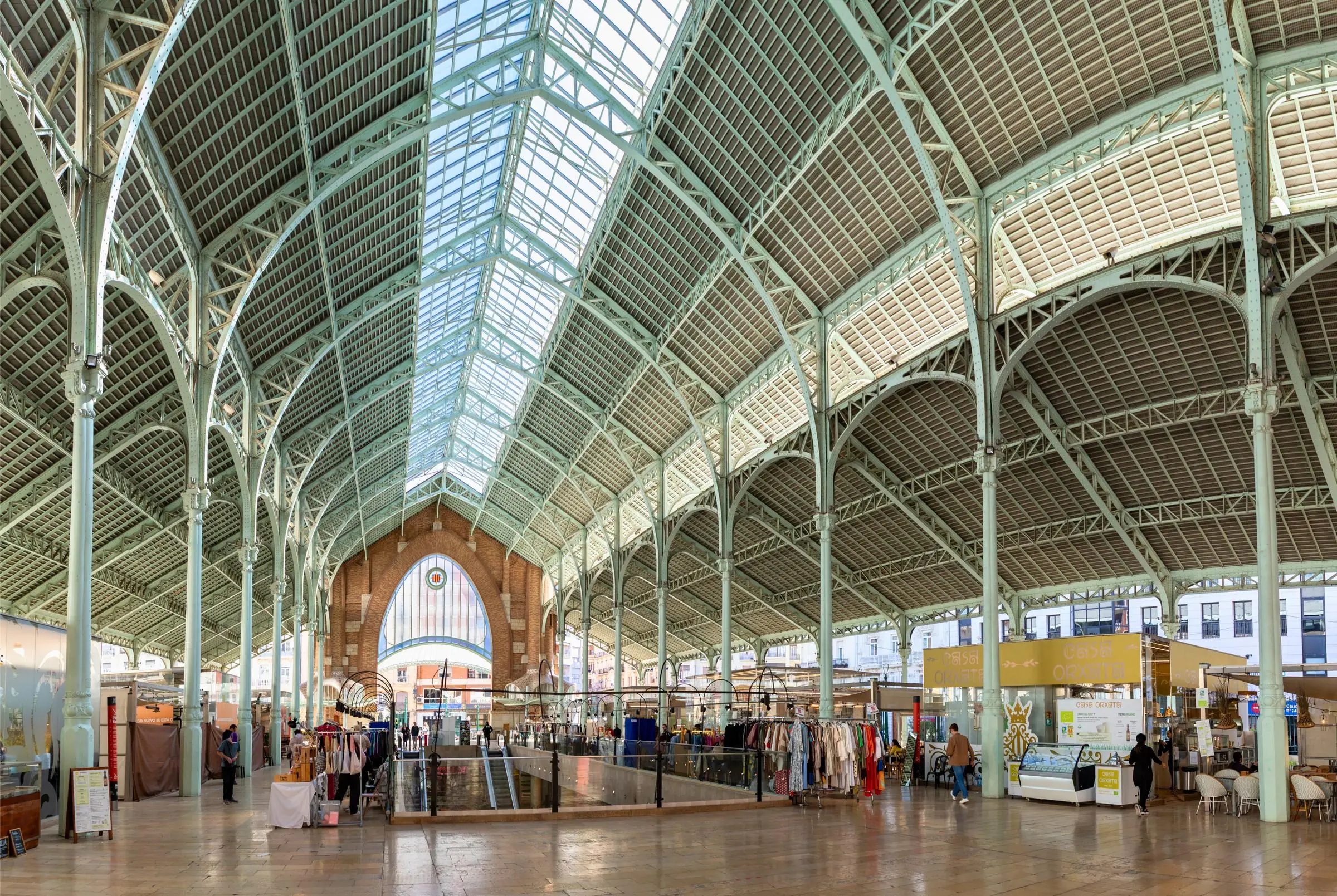
Mora Berenguer was heavily influenced by Antoni Gaudí and the Catalan Modernisme movement, and it shows. The building is framed by massive, parabolic iron arches that create a soaring, light-filled canopy. Unlike the closed-off stone buildings of the era, the market is completely open at both ends, allowing the Mediterranean breeze to flow through. Take a moment to stand in the center of the ground floor and look up at the intricate brickwork and the glass-and-iron roof structure—it is a masterclass in early 20th-century industrial design.
2. Valencian Ceramic Tile Friezes
The true local character of the building is baked into its ceramics. The facades on Carrer de Jorge Juan and Carrer de Cirilo Amorós are decorated with vibrant, polychrome tile mosaics. These friezes depict romanticized scenes of Valencian rural life: farmers harvesting oranges, women in traditional fallera dresses, and the agricultural bounty of the huerta (the fertile farmlands surrounding the city). The tilework serves as a permanent homage to the people who originally supplied the market’s food.
3. Underground Craft Beer Taprooms
Head down the escalators to the lower level to find Las Cervezas del Mercado. This subterranean bar is a haven for craft beer enthusiasts. While Valencia is traditionally a wine and vermouth city, this taproom boasts an impressive, rotating selection of local Spanish craft beers and international imports on draft, plus hundreds of bottles. The lower level stays naturally cooler during the sweltering summer months, making it a highly practical retreat for an afternoon pint.
4. Gourmet Horchateria Stalls
You cannot visit Valencia without trying horchata (a sweet, milky drink made from tiger nuts), and Mercado de Colón houses two of the best outposts in the city.
- Horchatería Daniel: A legendary institution originally from the nearby town of Alboraya. Their stall on the ground floor serves classic liquid horchata alongside fartons (light, glazed pastries meant for dipping).
- Casa de l’Orxata: Located on the same floor, they focus on organic (bio) tiger nuts and offer a slightly less sweet, more earthy version of the drink.
If you want to understand the 80-million-year history of the tiger nut and how horchata is made, consider joining a specialized tasting tour.
5. Upscale Tapas Terraces
The ground floor is ringed with open-air terraces that blur the line between indoor and outdoor dining. Mi Cub is a standout, offering seasonal tapas based on ingredients sourced directly from the Central Market. For something more substantial, head downstairs to Habitual, a Mediterranean restaurant by Ricard Camarena, one of Valencia’s most celebrated Michelin-starred chefs. The terraces are heated in the winter and shaded in the summer, making them a reliable choice year-round.
Advice for Different Types of Travelers
For the Budget Traveler
Because Mercado de Colón is located in the affluent L’Eixample district, the restaurants here are priced at a premium. If you are on a strict budget, you don’t have to skip the market. Entry is completely free. The best budget hack is to grab a coffee (around €2) or a standard horchata (around €3.50) at one of the ground-floor kiosks. You get to sit in the same stunning architectural space and enjoy the exact same atmosphere for the price of a beverage.
For Families
The market is exceptionally family-friendly. The ground floor is entirely pedestrianized and flat, making it easy to navigate with a stroller. Because the space is enclosed but open-air, kids have a bit of room to move without the danger of street traffic. The horchaterias are a massive hit with children, and the public restrooms on the lower level are generally kept very clean.
For the Time-Poor (30-Minute Visit)
If you are rushing between the City of Arts and Sciences and the Old Town, you can experience the market in half an hour.
- Enter via the Jorge Juan facade to photograph the ceramic tiles.
- Walk straight down the center aisle, looking up at the ironwork.
- Stop at Horchatería Daniel for a quick horchata and farton to-go.
- Exit via the Cirilo Amorós side.
Evening Bar Etiquette & Local Tips
When the sun goes down, Mercado de Colón transitions from a relaxed cafe hub into a bustling after-work social scene. Navigating the terraces requires a bit of local know-how.
- The “Turno” (Shift): Spanish dining times apply here. The terraces fill up for tardeo (afternoon drinks) between 5:00 PM and 8:00 PM. Dinner doesn’t truly start until 9:00 PM or 9:30 PM.
- Seating Yourself: At most casual terrace bars on the ground floor, you do not wait to be seated. If you see an empty table, claim it. A waiter will eventually come to you. However, for the upscale restaurants on the lower level (like Habitual), you must see the host.
- Ordering: Menus are often accessed via QR codes taped to the tables. When ordering drinks, asking for a doble gets you a standard large beer, while a caña is a small glass.
- Paying: Waiters will not bring the bill until you explicitly ask for it (“La cuenta, por favor”). It is considered rude to rush you out.
- Tipping: Tipping is not mandatory in Spain. If the service was excellent, leaving the small change (rounding up to the nearest Euro, or leaving €1-€2 on a larger bill) is appreciated but never expected.
Peak Hours: On Friday and Saturday evenings from 7:30 PM onwards, finding a table on the ground floor can be incredibly difficult. If you want a guaranteed seat for evening drinks, arrive by 6:30 PM.
Logistics: Getting There & Around
Mercado de Colón is located at Carrer de Jorge Juan, 19. It sits right in the heart of the grid-like L’Eixample neighborhood, known for its high-end boutiques and wide, tree-lined streets.
By Metro: The closest metro station is Colón (Lines 3, 5, 7, and 9). From the station exit, it is a flat, easy 3-minute walk down Carrer de Jorge Juan. If you plan on using public transit frequently, picking up a Valencia Tourist Card covers all your metro and bus rides.
Walking:
- From the Cathedral: 15 minutes.
- From the North Train Station (Estació del Nord): 10 minutes.
- From the Turia Gardens: 5 minutes.
Where to Stay Nearby
L’Eixample (and the adjacent Ruzafa neighborhood) is arguably the best area to stay in Valencia if you want a mix of excellent dining, safe streets, and proximity to both the historic center and the modern City of Arts and Sciences.
Use the map below to find hotels and apartments within walking distance of Mercado de Colón.
Frequently Asked Questions
Is there an entrance fee for Mercado de Colón?
No, entry to the market building is completely free. You only pay for the food and drinks you consume at the individual stalls and restaurants.
What are the opening hours for the market?
The building itself is generally open from 7:30 AM to 2:00 AM (extending to 3:00 AM on Fridays and Saturdays). However, individual cafes and restaurants set their own hours. Most coffee shops open by 8:00 AM, while the tapas bars and restaurants get busy around 1:00 PM and again after 8:00 PM.
Can I buy fresh produce or seafood here?
No. Despite the name “Mercado” (Market), this is a gourmet food hall. If you want to buy raw ingredients, fresh fish, or local produce, you need to visit the Central Market or the Ruzafa Market.
Is Mercado de Colón wheelchair accessible?
Yes. The ground floor is entirely flat and pedestrianized, making it easy to navigate. There are elevators and escalators providing access to the lower level, where you will also find accessible public restrooms.
Do the restaurants inside take credit cards?
Yes, virtually all the cafes, bars, and restaurants inside Mercado de Colón accept major credit cards (Visa and Mastercard). Contactless payment via phone is also widely used.
Is it a good place to go when it rains in Valencia?
Yes. While the ends of the building are open to the air, the massive roof provides excellent shelter. The lower level is completely enclosed, making it a great refuge during a sudden Mediterranean downpour.