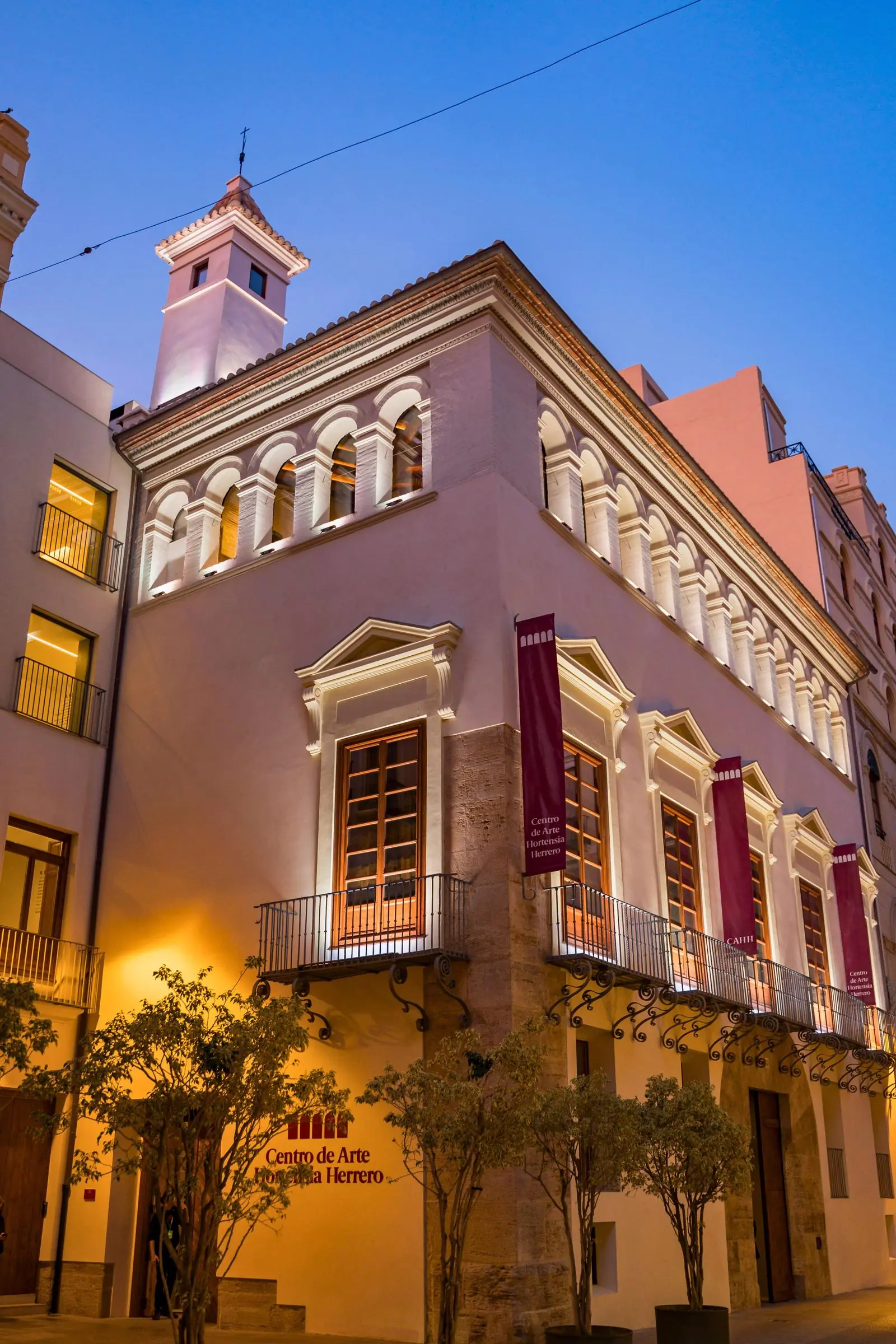
Opened in late 2023, the Centro de Arte Hortensia Herrero (CAHH) is Valencia’s most significant recent cultural addition. Housed in the meticulously restored 17th-century Valeriola Palace in the Ciutat Vella, the museum showcases the private contemporary art collection of local patron Hortensia Herrero.
What makes this space distinct isn’t just the caliber of the art—which includes works by David Hockney, Anselm Kiefer, and Sean Scully—but the building itself. A visit here is a walk through Valencia’s history, taking you from 3rd-century Roman ruins in the basement to cutting-edge digital installations on the upper floors.
Because the museum tightly controls capacity to protect the historic building, planning ahead is necessary. Here is how to navigate the space, what to look out for, and how to choose the right ticket.
The Hortensia Herrero Art Center operates on a timed-entry system. Because the building has narrow historic corridors, daily capacity is strictly limited. Walk-up tickets are rarely available, especially on weekends.
The Architecture: Restoring the Valeriola Palace
Before looking at the art, it helps to understand the building. The Palacio Valeriola was built in the early 17th century by a wealthy family of Jewish descent who had converted to Christianity. Over the centuries, the building served as a printing press, a nightclub, and eventually sat abandoned and decaying.
The restoration, led by ERRE Arquitectura, took five years. The architects managed to save the original wooden eaves, the grand stone staircase, and the baroque ceiling frescoes. They also constructed a modern annex next door, connecting the two buildings with glass walkways. The result is a stark, intentional contrast: you will walk out of a dark, 400-year-old wooden room directly into a bright, minimalist concrete gallery.
5 Highlights of the Collection
The collection spans over 100 works by more than 50 contemporary artists. While the art rotates, several spaces were designed specifically for permanent, site-specific installations.
1. The Subterranean Roman Circus
During the renovation, excavators hit a massive archaeological find: a section of Valencia’s 3rd-century Roman circus (chariot racing track). Instead of covering it up, the museum integrated the ruins into the basement. You can walk on glass floors suspended directly over the ancient stone walls, offering a rare glimpse into the Roman city of Valentia.
2. Sean Scully’s Glass Chapel
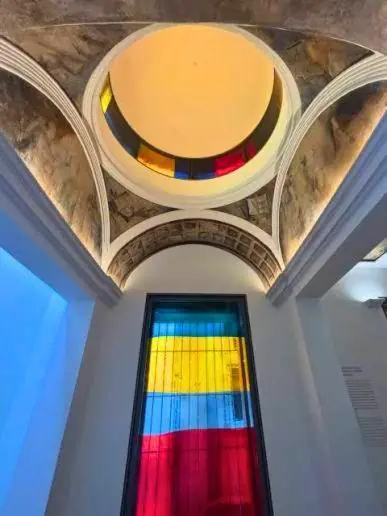
The palace’s original private chapel has been completely reimagined by Irish-born artist Sean Scully. He replaced the traditional religious iconography with his signature geometric abstraction. The space features massive, luminous stained-glass windows that cast blocks of colored light across the restored 17th-century walls, creating a quiet, contemplative atmosphere.
3. David Hockney Installations
Hockney’s vibrant, multi-perspective works occupy a significant portion of the modern annex. The highlight is a dedicated room showcasing his iPad drawings, which document the changing seasons in Normandy. The bright, saturated colors of the digital prints stand out sharply against the raw concrete walls of the new building.
4. The Anselm Kiefer Gallery
German artist Anselm Kiefer is known for his monumental, heavily textured canvases that deal with history and myth. The museum has dedicated a large, high-ceilinged room to his work. The sheer scale of these pieces—often incorporating lead, straw, and ash—requires a massive space to be fully appreciated, and the gallery provides the necessary breathing room.
5. The Central Courtyard
The traditional Valencian courtyard serves as the physical and visual center of the museum. It is open to the sky and features rotating large-scale sculptures. Currently, it houses a delicate, suspended installation by Tomás Saraceno that resembles a cluster of metallic clouds, reflecting the surrounding historic arches and the visitors walking below.
Tickets: General Admission vs. Guided Tours
You have two main ways to see the museum: exploring on your own or taking an official guided tour.
General Admission Ticket
- Access to all galleries and the Roman ruins
- Explore at your own pace
- Free multimedia guide via smartphone app
- Best for those who want to focus purely on the art
Entry + Official Guided Tour
- 90-minute tour led by an art historian
- Deep dive into the 5-year architectural restoration
- Context on the site-specific installations
- Only costs €3 more than standard entry
Which ticket should you choose?
- The Guided Tour is the clear winner here.
- For an extra €3, the context provided about the Roman ruins and the palace’s history is invaluable.
- The guides explain the complex engineering required to save the building.
- Tours are scheduled at specific times and run strictly for 90 minutes.
- If you prefer to rush through museums or linger for hours in a single room, stick to General Admission.
Note: You can also check availability for both options via GetYourGuide.
Advice for Different Types of Travelers
For Budget Travelers: The museum offers free entry on Wednesday afternoons from 4:00 PM until closing. However, you cannot simply walk in. Free tickets are released on the museum’s official website in batches and get snapped up almost immediately. If you want to go for free, you need to monitor their site weeks in advance.
For the Time-Poor: If you only have an hour, skip the multimedia guide. Head straight down to the basement to see the Roman circus, then walk up the main stone staircase to the Sean Scully chapel. Finish by crossing the glass bridge into the modern annex to see the Hockney room.
For Families: This is a quiet, contemplative contemporary art space. There are no interactive children’s exhibits, and touching the art is strictly prohibited. If you are traveling with young, energetic children, the Science Museum or Bioparc are much better options for your itinerary.
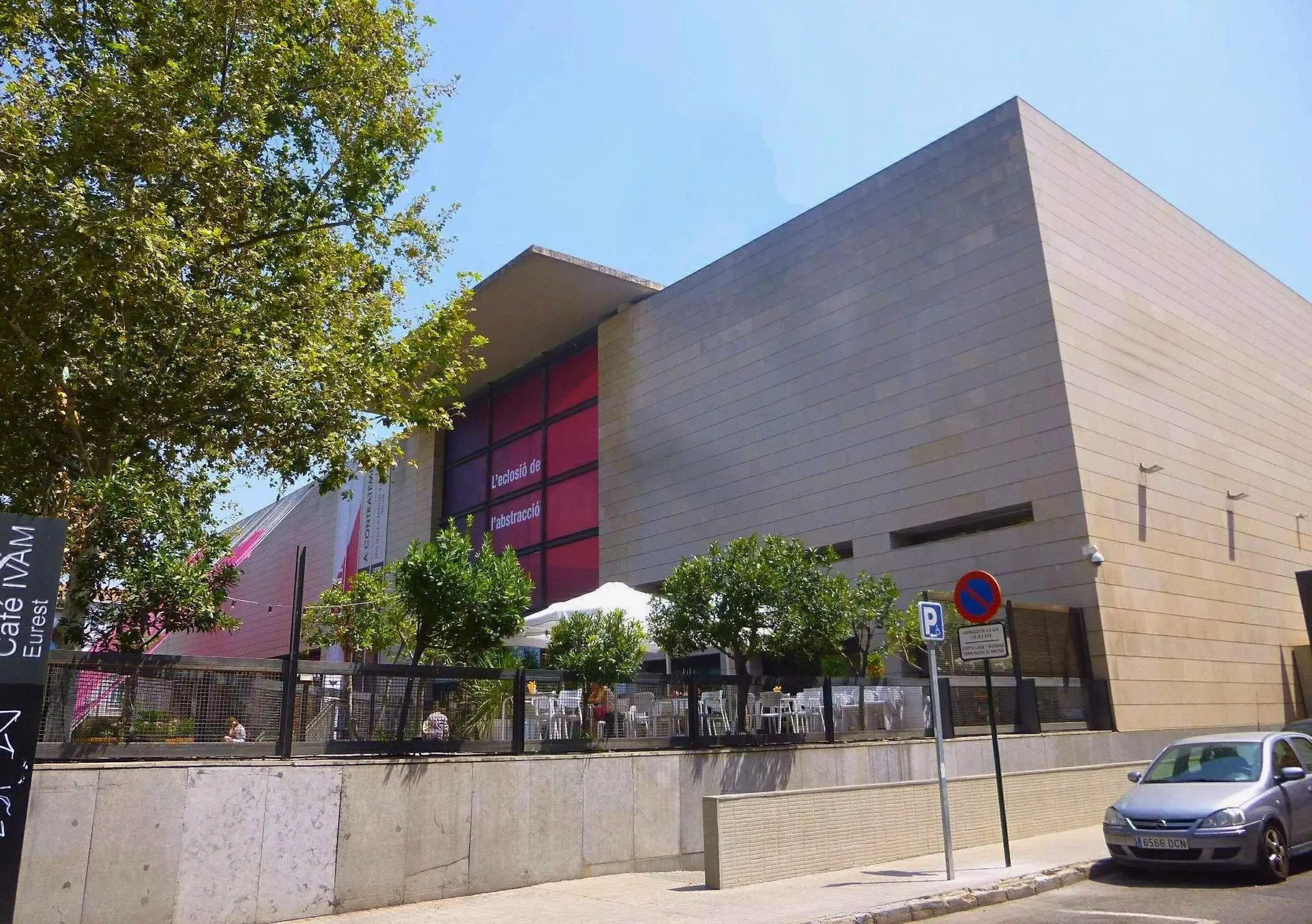
Keep Planning: If you enjoy modern art, pair this visit with a trip to the IVAM (Valencian Institute of Modern Art), located about a 15-minute walk away on the edge of the old town.
Logistics & Practical Tips
Getting There
The museum is located at Calle del Mar, 31, right in the historic center.
- Walking: It is a 5-minute walk from the Valencia Cathedral and Plaza de la Reina.
- Metro: The closest metro station is Colón (Lines 3, 5, 7, 9), about an 8-minute walk away.
- Bus: EMT bus lines 4, 10, 31, and 71 stop nearby on Calle de la Paz.
When to Visit
The museum is closed on Mondays. Weekday mornings (Wednesday through Friday) are the quietest times to visit. Weekends get crowded, and the narrow corridors in the historic side of the building can feel congested.
Accessibility
Despite being a 17th-century palace, the restoration prioritized accessibility. Elevators connect all floors, and ramps are available where there are slight level changes. The glass floors over the Roman ruins are fully wheelchair accessible.
Bag Policy: Large backpacks, umbrellas, and bulky items are not allowed in the galleries. There are free lockers available on the ground floor near the ticket desk. You will need a €1 coin to use them (the coin is returned when you retrieve your items).
Where to Stay Nearby
The area around the museum (La Seu / Xerea neighborhoods) is one of the best places to stay in Valencia. It is quiet, historic, and within walking distance of almost every major central attraction.
Frequently Asked Questions
How much time do I need to visit the Hortensia Herrero Art Center?
Most visitors spend between 90 minutes and 2 hours exploring the museum. If you are using the multimedia guide and listening to every track, expect to be there for closer to 2.5 hours.
Is the museum included in the Valencia Tourist Card?
No, the Centro de Arte Hortensia Herrero is a private institution and is not currently included in the standard Valencia Tourist Card. You must purchase a separate ticket.
Can I take photographs inside?
Yes, photography without a flash is permitted in almost all galleries for personal use. Tripods and selfie sticks are strictly prohibited. Occasionally, specific temporary loans may have “no photography” signs, so keep an eye out.
Is there a café or restaurant inside the museum?
No, the museum does not have an internal café. However, because it is located on Calle del Mar, you are steps away from dozens of excellent cafes and restaurants in the Ciutat Vella.
Do I need to print my ticket?
No, digital tickets on your smartphone are perfectly fine. The staff will scan the QR code directly from your screen at the main entrance.