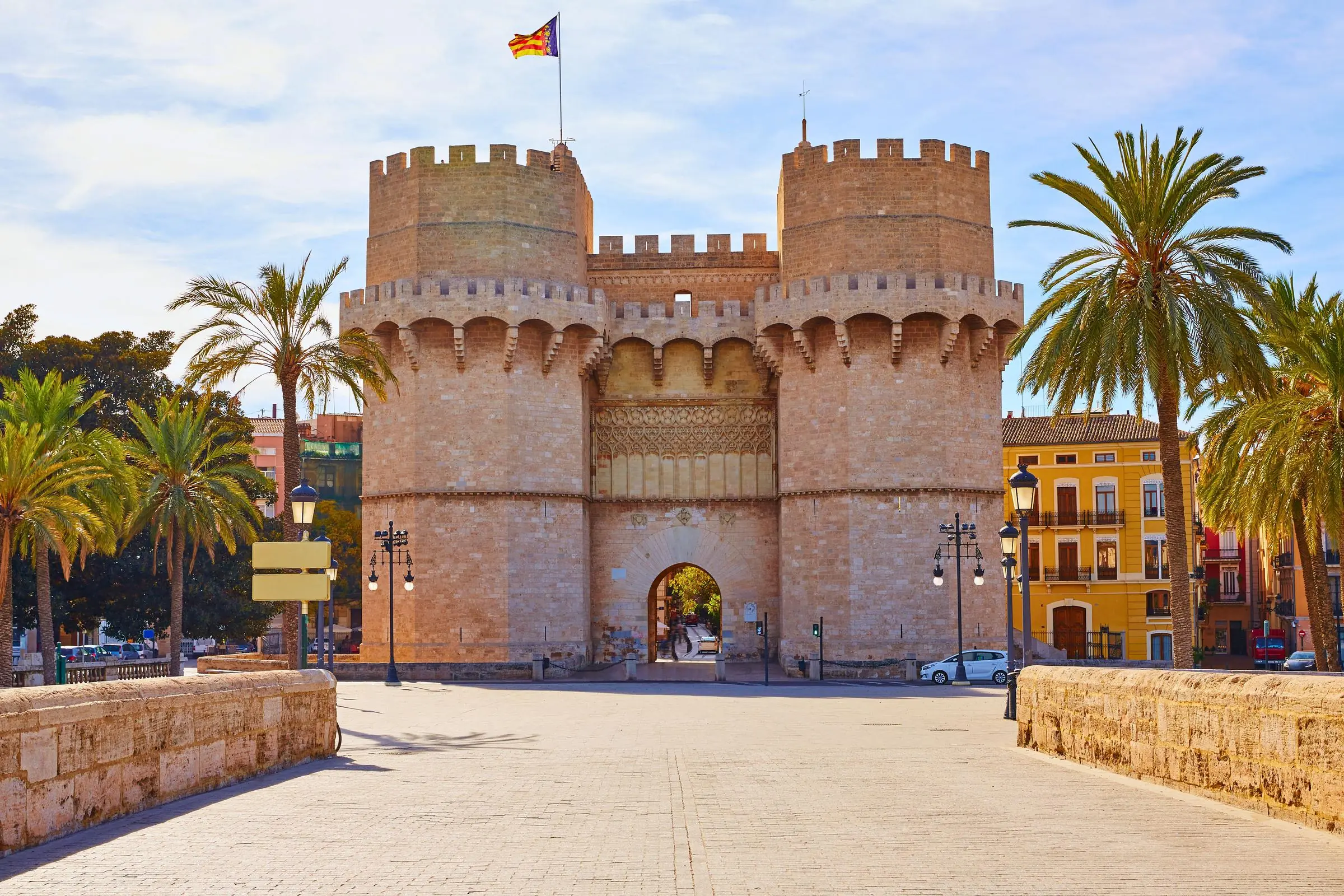
Standing at the northern edge of Valencia’s Ciutat Vella, the Serranos Towers (Torres de Serranos) are impossible to miss. Built between 1392 and 1398 by architect Pere Balaguer, this massive Gothic structure was once the main entrance to the city for travelers arriving from the north.
Today, it is one of only two surviving gates from the medieval city walls (the other being the Quart Towers). While it looks like a heavy military fortress from the outside, a walk through its archway reveals an entirely different, open-backed structure designed with a very specific defensive purpose.
Whether you want to climb the battlements for panoramic views over the Turia Gardens or simply admire the stonework from the ground, here is the practical information you need to plan your visit.
History: From Triumphal Arch to Art Vault
The Serranos Towers were designed to be intimidating, but their primary historical function was ceremonial. Because of their grand appearance, they served as the official triumphal arch for kings and ambassadors entering Valencia.
In 1586, after a fire damaged the city’s main prison, the towers were repurposed to hold noblemen and knights. This change in function is actually what saved the structure from destruction. When the city government ordered the demolition of the medieval walls in 1865 to allow for urban expansion, the Serranos Towers were spared because they were still actively being used as a prison.
During the Spanish Civil War (1936–1939), the towers took on another critical role. As Madrid came under bombardment, the Spanish government evacuated the most valuable paintings from the Prado Museum—including works by Velázquez and Goya—to Valencia. A massive, climate-controlled concrete vault with a 90-centimeter-thick reinforced ceiling was constructed inside the lowest level of the Serranos Towers to protect the art from air raids. The vault successfully shielded the paintings until they were moved to Geneva later in the war.
Look closely at the stone: As you approach the front facade, you can still see the intricate Gothic tracery and the coats of arms of the Kingdom of Valencia and the city, carved directly into the limestone.
5 Highlights of the Serranos Towers
If you decide to pay the municipal entry fee and climb the structure, these are the five architectural and historical details to look out for.
1. The Twin Polygonal Stone Towers
Unlike standard square or cylindrical defensive towers, the Serranos Towers are polygonal. This specific geometric design was chosen to deflect cannonballs and projectiles more effectively than flat surfaces, while eliminating the blind spots associated with round towers. The heavy masonry is made of solid limestone brought from nearby quarries in Alginet.
2. Rear Open-Throat Defense Galleries
When you walk through the gate and look back at the towers from the Old Town side, you will notice the structure is completely open, revealing five large vaulted galleries. This “open-throat” design was a deliberate military failsafe. If enemy forces managed to breach the gate and take control of the towers, they would have no rear wall to protect them from the city’s own archers and cannons firing back at them from the streets.
3. Battlements Viewing Platforms
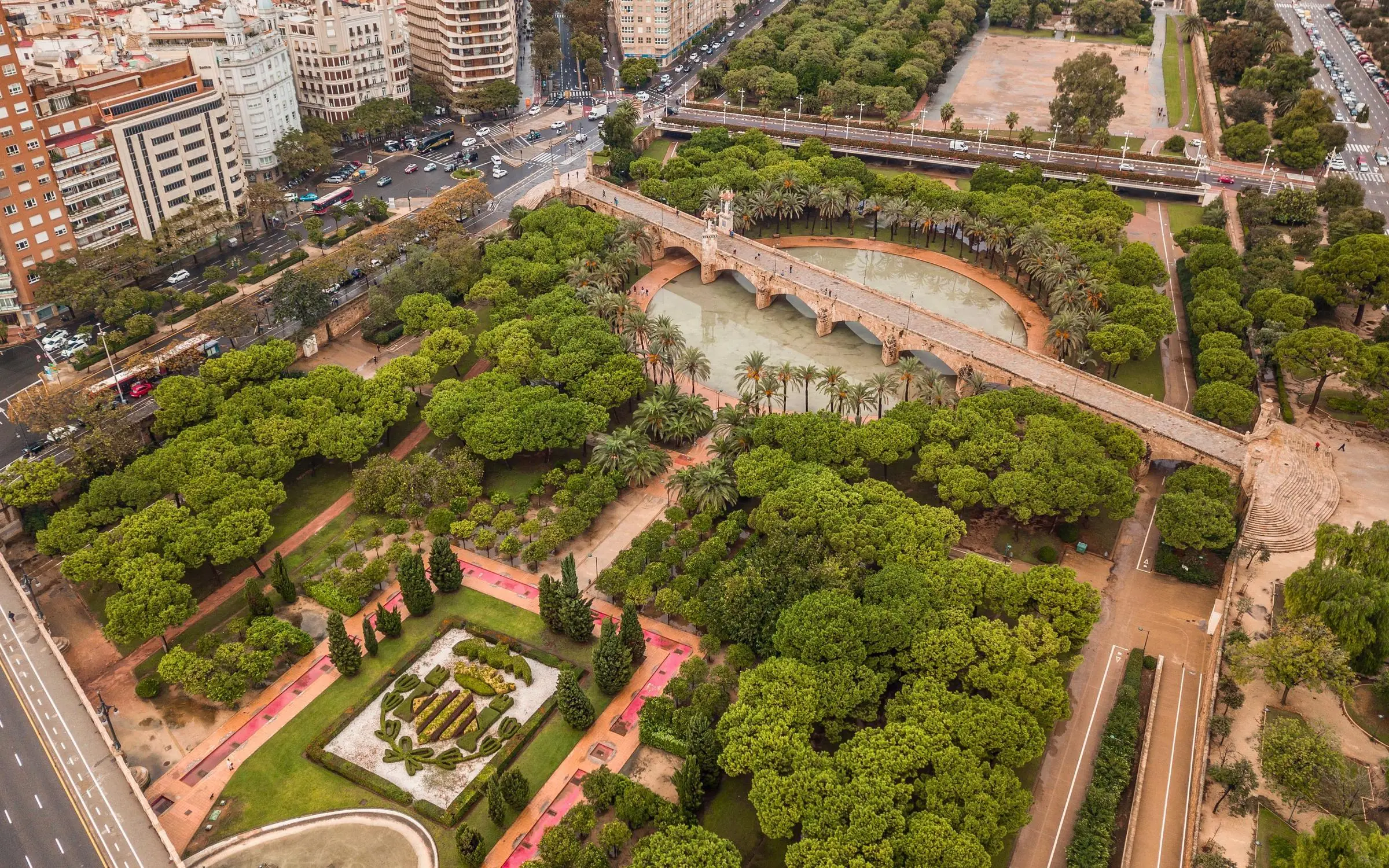
The main draw for visitors is the climb to the top. A series of steep, narrow stone staircases leads you up through the open galleries to the crenellated battlements. From the highest platform, you get a clear, unobstructed view over the rooftops of the historic center to the south, and the sprawling green ribbon of the Turia Park to the north.
4. Surviving Portcullis Slots
As you stand directly under the main central archway, look straight up. You can clearly see the deep vertical grooves carved into the stone where the heavy wooden and iron portcullis (drop gate) would have been lowered to seal the city during an attack or a plague lockdown.
5. The Crida Fallas Balcony
If you visit Valencia in late February, you will see a massive stage built directly in front of the towers. The lower rear balcony of the Serranos Towers is the traditional site of La Crida—the official opening ceremony of the Las Fallas festival. The Fallera Mayor (the festival queen) stands on this balcony to declare the start of the festivities to tens of thousands of people gathered below.
Keep Planning: If you are visiting during the festival season, read our complete Las Fallas Guide.
Logistics: Tickets, Fees & Hours
The Serranos Towers are managed by the Valencia municipal government, which means entry is very affordable compared to private attractions.
Entry Fees & Practical Info
General Admission
- Standard adult ticket purchased at the gate.
Reduced Rate
- For students, pensioners, and children aged 7-12.
Sundays & Holidays
- Entry is free for everyone on Sundays and municipal holidays.
Opening Hours:
- Monday to Saturday: 10:00 AM – 7:00 PM
- Sundays and Holidays: 10:00 AM – 2:00 PM
- Note: The towers close during heavy rain or high winds due to the slip hazard on the exposed stone steps.
Because entry is free on Sundays, the narrow staircases can become congested between 11:00 AM and 1:00 PM. If you are visiting on a Sunday, arrive right at 10:00 AM to avoid waiting in line at the base of the stairs.
The Valencia Tourist Card
If you plan to use public transport and visit multiple municipal sites (like the La Lonja de la Seda or the Almoina Archaeological Center), the Valencia Tourist Card includes free, skip-the-ticket-desk entry to the Serranos Towers.
How to Get There & Turia Park Access
The towers sit at the junction of Plaça dels Furs (inside the old town) and Pont dels Serrans (the bridge crossing the Turia park).
- From the Old Town: Walk straight up Calle de Serranos or Calle de Navellos from the Valencia Cathedral. It is a flat, 10-minute walk.
- From Turia Park: If you are cycling or walking through the Turia Gardens, the towers are located at Section 4 of the park. There are wide ramps and stairs leading directly up from the sunken park to street level right at the base of the towers.
- By Bus: EMT Bus lines C2, 6, 11, 16, 26, 80, and 94 drop you right outside the gate on the ring road (Carrer de la Blanqueria).
Advice for Different Traveler Types
For Budget Travelers At €2, this is already one of the cheapest historical sites in the city. To make it completely free, time your visit for a Sunday morning. You do not need to book Sunday tickets in advance; simply walk up to the gate.
For Families with Children Kids generally love climbing the “castle,” but parents should be aware that the stone steps are steep, uneven, and lack modern handrails in certain sections. There is no elevator. Strollers must be left at the ground-level ticket booth. Keep a close eye on toddlers on the upper battlements, as the historic stone walls are relatively low in places.
For the Time-Poor You only need 20 to 30 minutes to climb to the top, take photos, and come back down. If you don’t have time to climb, you can still walk through the central archway for free at any time of day to see the open-throat galleries from the rear plaza.
Tours Including the Serranos Towers
Because the towers are the most prominent gateway into the historic center, many walking and cycling tours use them as a starting point or a major stop. Taking a guided medieval walking tour provides excellent context on how the city walls functioned before they were torn down.
Where to Stay Nearby
The area immediately surrounding the Serranos Towers (the northern edge of the El Carmen neighborhood) is an excellent base for exploring Valencia. It places you right on the edge of the Turia Park (great for morning runs or bike rentals) while keeping you within a 10-minute walk of the Cathedral and the Central Market.
Keep Planning: For a deeper dive into the city’s districts, read our guide on Where to Stay in Valencia.
Frequently Asked Questions
Is there an elevator in the Serranos Towers?
No. Because it is a preserved 14th-century military structure, access to the upper levels is strictly via the original steep stone staircases. It is not wheelchair accessible beyond the ground floor archway.
How long does it take to visit the Serranos Towers?
Most visitors spend about 30 minutes here. This is enough time to buy a ticket, climb the two levels of stairs, take photos from the roof, and descend.
What is the difference between the Serranos Towers and the Quart Towers?
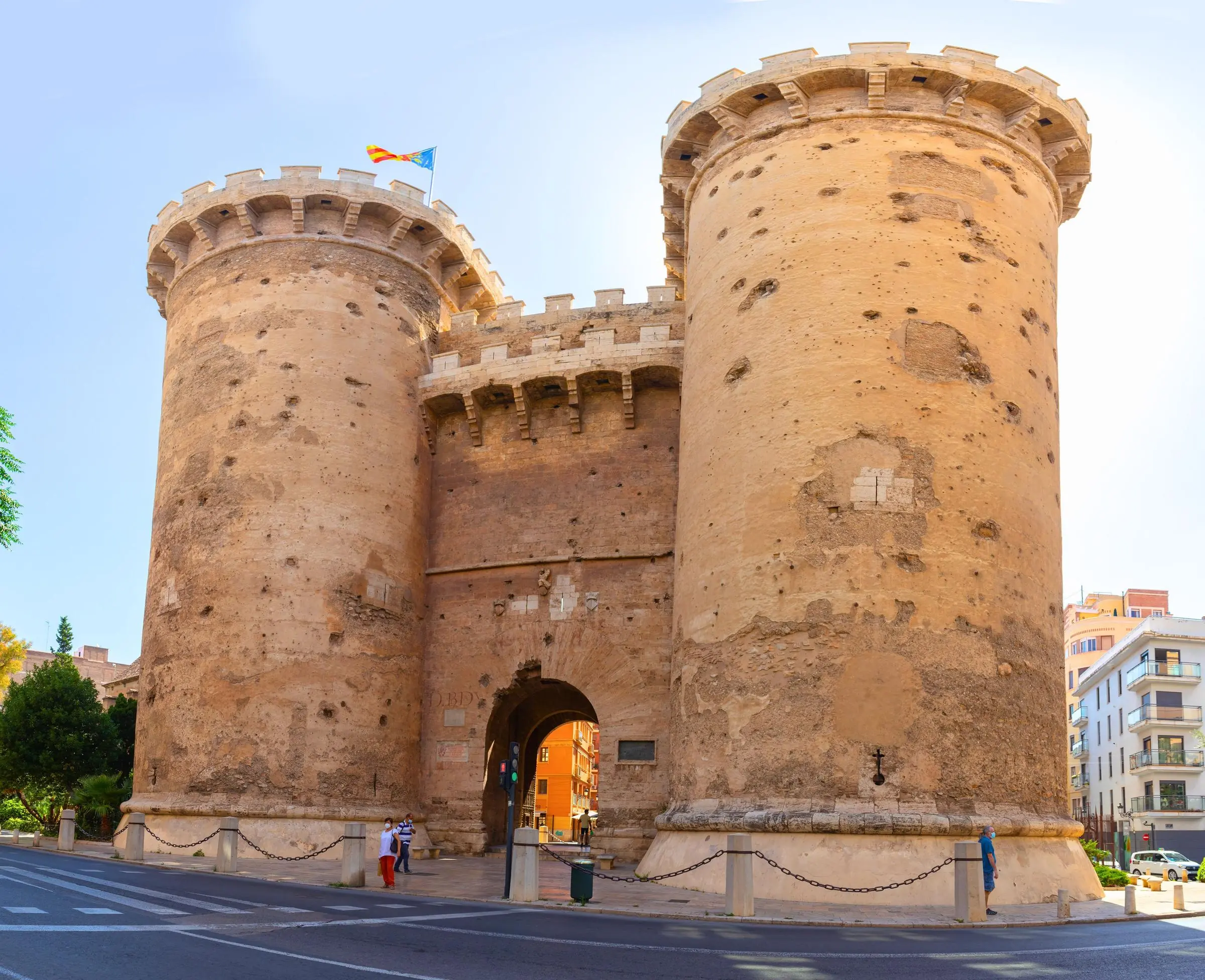
Both are surviving medieval gates, but they have different shapes and histories. The Serranos Towers are polygonal and were used as a ceremonial entrance and a prison. The Quart Towers are cylindrical, have a more rugged military appearance, and still bear the visible impact craters from cannonballs fired by Napoleon’s troops in 1808.
Can you walk on the old city walls from the towers?
No. The medieval walls that once connected to the towers were demolished in 1865 to allow the city to expand. You can only walk on the footprint of the towers themselves.
Are the Serranos Towers safe to visit at night?
You cannot climb the towers after 7:00 PM, but walking through the archway and around the plaza at night is very safe. The towers are beautifully illuminated after dark, making them a popular spot for evening photography.
Do I need to book tickets in advance?
No, advance booking is not necessary. You can easily buy your €2 ticket at the small booth located inside the archway when you arrive. If you have a Valencia Tourist Card, simply show it at the booth.