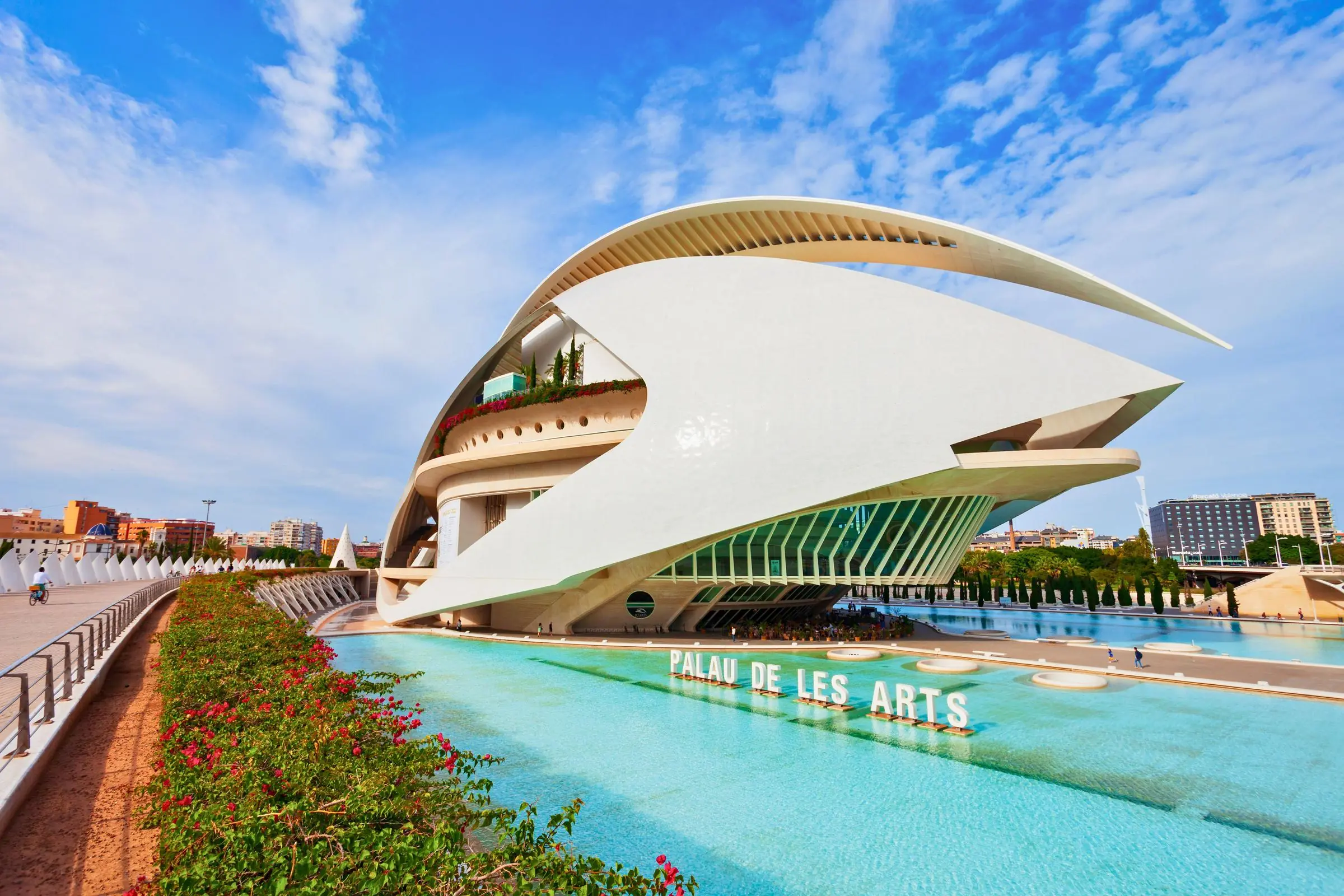
Anchoring the western edge of Valencia’s City of Arts and Sciences, the Palau de les Arts Reina Sofia is a 75-meter-tall performing arts center that looks like a cross between a Spartan helmet and a deep-sea leviathan. Designed by Valencia-born architect Santiago Calatrava, it is one of the tallest opera houses in the world.
While many visitors simply photograph its sweeping white concrete and mosaic-tiled exterior from the adjacent Turia Gardens, going inside reveals a complex labyrinth of acoustic engineering and multi-tiered performance spaces.
Whether you are attending a three-hour Wagner opera, taking a daytime architectural tour, or just trying to figure out if you can wear jeans to a performance, this guide breaks down exactly how to navigate the Palau de les Arts.
Is the Palau de les Arts for You?
The building serves two distinct purposes: it is a working theater for evening performances, and an architectural museum during the day. Here is how to approach it based on your travel style:
- For Architecture Enthusiasts: The expert guided tour is the only way to fully understand the structural math behind the building. You will get access to areas normally restricted to performers.
- For Time-Poor Visitors: If you only have one day in Valencia, skip the interior tour. Walk the exterior perimeter, take your photos from the reflecting pools, and spend your time inside the Oceanogràfic or the Science Museum.
- For Classical Music Fans: Skip the daytime tours entirely and buy a ticket to an evening performance. The acoustics in the Main Sala are highly regarded, and seeing the building illuminated at night while filled with patrons is the intended experience.
- For Budget Travelers: You do not need to pay to see the exterior. If you want to see the inside without the premium price of a guided tour, the audio guide entry ticket allows you to walk the main public spaces at your own pace.
Calatrava’s Acoustic Feather Design
The defining feature of the Palau de les Arts is its sweeping outer shell. Often described as a “plume” or a “feather,” this massive steel structure hovers over the main auditoriums, seemingly defying gravity.
The shell is constructed from two overlapping sections of white concrete, coated in trencadís—the traditional Valencian technique of using shattered ceramic tiles to create a reflective, mosaic surface. This outer layer does not actually support the auditoriums inside; it acts as a protective, acoustic envelope that shields the performance spaces from the noise of the nearby highway and the city.
The building spans 40,000 square meters and houses four distinct performance venues. Navigating it can be slightly disorienting due to the lack of straight lines and traditional right angles.
Because this is a working theater, daytime tours are heavily dependent on rehearsal schedules. Some rooms may be closed to the public on the day of your visit if an orchestra is practicing.
5 Highlights of the Palau de les Arts
If you take a daytime tour, you will be guided through a specific route. Here are the five key areas that define the building’s interior.
1. The Main Sala (Sala Principal)
This is the heart of the building. Seating 1,400 people across four tiers, the Main Sala is primarily used for opera and ballet. The room is visually striking, completely clad in deep blue acoustic panels that contrast sharply with the stark white exterior of the building. The acoustics here are engineered to carry unamplified voices clearly to the highest balcony. If you take the guided tour, you will usually get to sit in the stalls and see the massive orchestra pit, which is the third largest in the world.
2. The Panoramic Terraces
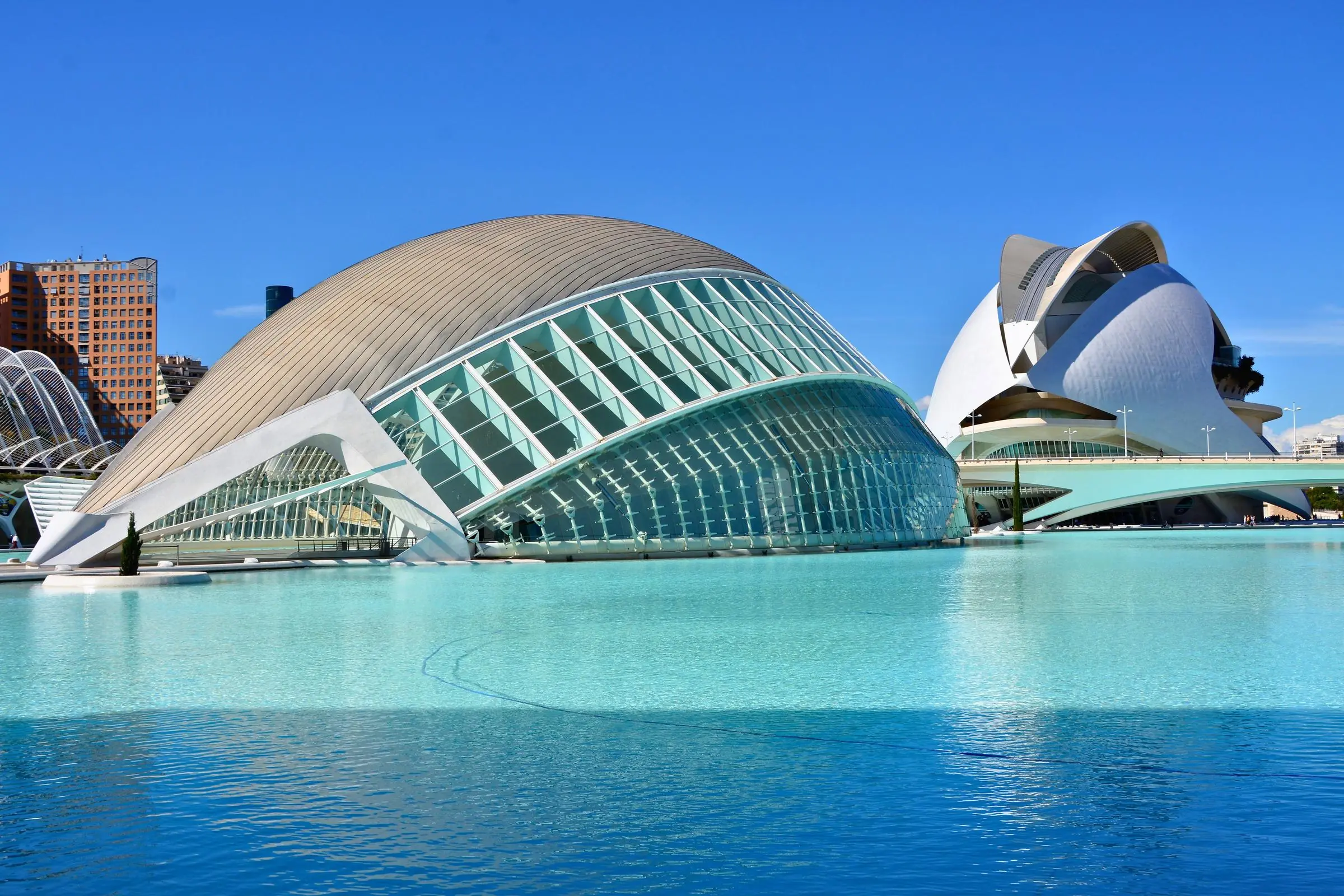
Calatrava designed the building to be open to the Mediterranean climate. The upper terraces are accessible via exterior glass elevators and sweeping staircases. From these platforms, you get unobstructed views over the Turia riverbed, the Hemisfèric, and the Valencia skyline. The terraces are characterized by their integration of indoor and outdoor space, shaded by the massive steel “feather” overhead.
3. Martí i Soler Subterranean Theater
Named after the 18th-century Valencian composer Vicente Martín y Soler, this venue is located entirely below ground level. It seats 400 people and is used for chamber music, smaller theatrical productions, and the center’s training academy. Because it is subterranean, the acoustic isolation is absolute. The design here is much more intimate, featuring warm wood paneling that contrasts with the industrial steel of the upper levels.
4. The Helga de Alvear Gardens
Integrated into the structural terraces of the building are lush, elevated garden spaces. These areas feature Mediterranean flora, including palm trees and local shrubs, planted directly into the concrete architecture. The gardens serve as a visual break from the heavy steel and glass, providing a natural transition between the building and the surrounding Turia park.
5. Backstage Rehearsal Pods
One of the main advantages of the guided backstage tour is access to the rehearsal spaces. These are not your standard practice rooms. The vocal and instrumental rehearsal pods are acoustically isolated chambers suspended within the building’s framework. You can see the complex rigging systems, the costume staging areas, and the massive freight elevators used to move multi-ton stage sets from the loading docks to the Main Sala.
Ticket Types: Standard Entry vs. Guided Tours
If you want to see the interior during the day, you have a few options. The box office is located at the main entrance, but tours frequently sell out during peak season (April to October).
Entry + Audio Guide
- Access to the main public foyers and terraces.
- Downloadable audio app on your smartphone.
- Does not include backstage access.
- Good for visitors who want to move quickly.
Official Guided Tour
- 1-hour tour led by an official Palau guide.
- Access to the Main Sala and Martí i Soler theater.
- Access to backstage areas (rehearsal schedules permitting).
- Deep dive into Calatrava’s architectural engineering.
Verdict: The €4 price difference makes the guided tour the obvious choice. The building’s layout is confusing, and without a guide to explain the acoustic engineering and point out the structural details, the empty foyers can feel a bit sterile.
Keep Planning: If you are exploring the rest of the complex, read our guide on comparing Valencia city passes to see if a combined ticket saves you money.
Attending a Performance: Logistics & Dress Code
If you are buying tickets for an evening opera, ballet, or symphony, here is what you need to know about the local culture.
The Dress Code
Valencia is a stylish but relaxed city, and the dress code at the Palau de les Arts depends heavily on the specific event.
- Opening Nights & Premieres: Formal. Dark suits and ties for men; cocktail dresses or elegant evening wear for women.
- Standard Opera & Ballet Performances: Smart casual. A blazer with dark jeans or chinos is perfectly acceptable for men. Women typically wear blouses with trousers or skirts.
- Symphony & Chamber Music: Casual to smart casual.
- What is strictly forbidden: Beachwear, flip-flops, athletic shorts, and tank tops. You will be denied entry.
Box Office and Seating Tips
- Sightlines: The Main Sala has a horseshoe shape. If you buy tickets in the side boxes (Palcos), be aware that seats in the second or third row of the box may have partially obstructed views of the stage.
- Subtitles: Operas are typically performed in their original language. Subtitles are projected above the stage in Spanish and Valencian. English subtitles are rarely provided.
- Cloakroom: There is a free cloakroom available. Large bags and backpacks must be checked before entering the auditoriums.
Logistics: Getting There & Practical Info
The Palau de les Arts is the building closest to the city center within the City of Arts and Sciences complex.
- By Bus: EMT local buses 13, 15, 19, 24, 25, and 95 all stop near the complex. Line 95 runs directly along the Turia riverbed and is usually the most convenient.
- By Metro: Take Metro Line 10 to the Ciutat Arts i Ciències - Justícia station. From there, it is a 5-minute walk to the Palau.
- Walking: It takes about 25 to 30 minutes to walk from the historic center (Ciutat Vella) through the Turia Gardens to the opera house.
- Accessibility: The building is fully wheelchair accessible, with ramps and elevators connecting all public levels and terraces. Accessible seating is available in all auditoriums, but must be requested when booking performance tickets.
Wind Closures: Because of the building’s aerodynamic shape and the heavy ceramic tiles on the exterior, the outdoor terraces and immediate perimeter are occasionally closed to the public during periods of extreme high winds for safety reasons.
Where to Stay Nearby
If you are in Valencia primarily to attend a performance, staying near the City of Arts and Sciences is convenient. The immediate area is modern, quiet, and features several upscale hotels. If you prefer a more lively atmosphere with historic charm, stay in the Ruzafa neighborhood, which is a 20-minute walk away.
Frequently Asked Questions
How long does the guided tour of the Palau de les Arts take?
The official guided tour lasts exactly one hour. You should arrive at the meeting point (usually the main box office area) 10 minutes before your scheduled start time.
Can I take photos inside the auditoriums?
During daytime guided tours, photography is generally allowed in the auditoriums, though flash is prohibited. During evening performances, taking photos or recording video inside the auditoriums is strictly forbidden and actively enforced by ushers.
Is there a restaurant inside the Palau de les Arts?
Yes, the building houses Contrapunto Les Arts, an upscale restaurant located on the ground floor beneath the main cantilever. It offers Mediterranean fusion cuisine and has an excellent outdoor terrace. Reservations are highly recommended, especially on performance nights.
Are children allowed on the guided tours?
Yes, children are welcome on the daytime tours. However, because the tour focuses heavily on architecture, acoustics, and history, very young children may find the one-hour walking tour tedious. Strollers can be accommodated via elevators.
Do I need to print my tour ticket?
No, digital tickets on your smartphone are perfectly acceptable for both daytime tours and evening performances. Ensure your screen brightness is turned up when scanning at the entrance.
What language are the guided tours in?
Tours are typically offered in English and Spanish. When booking your guided tour ticket, you will be prompted to select your preferred language time slot.