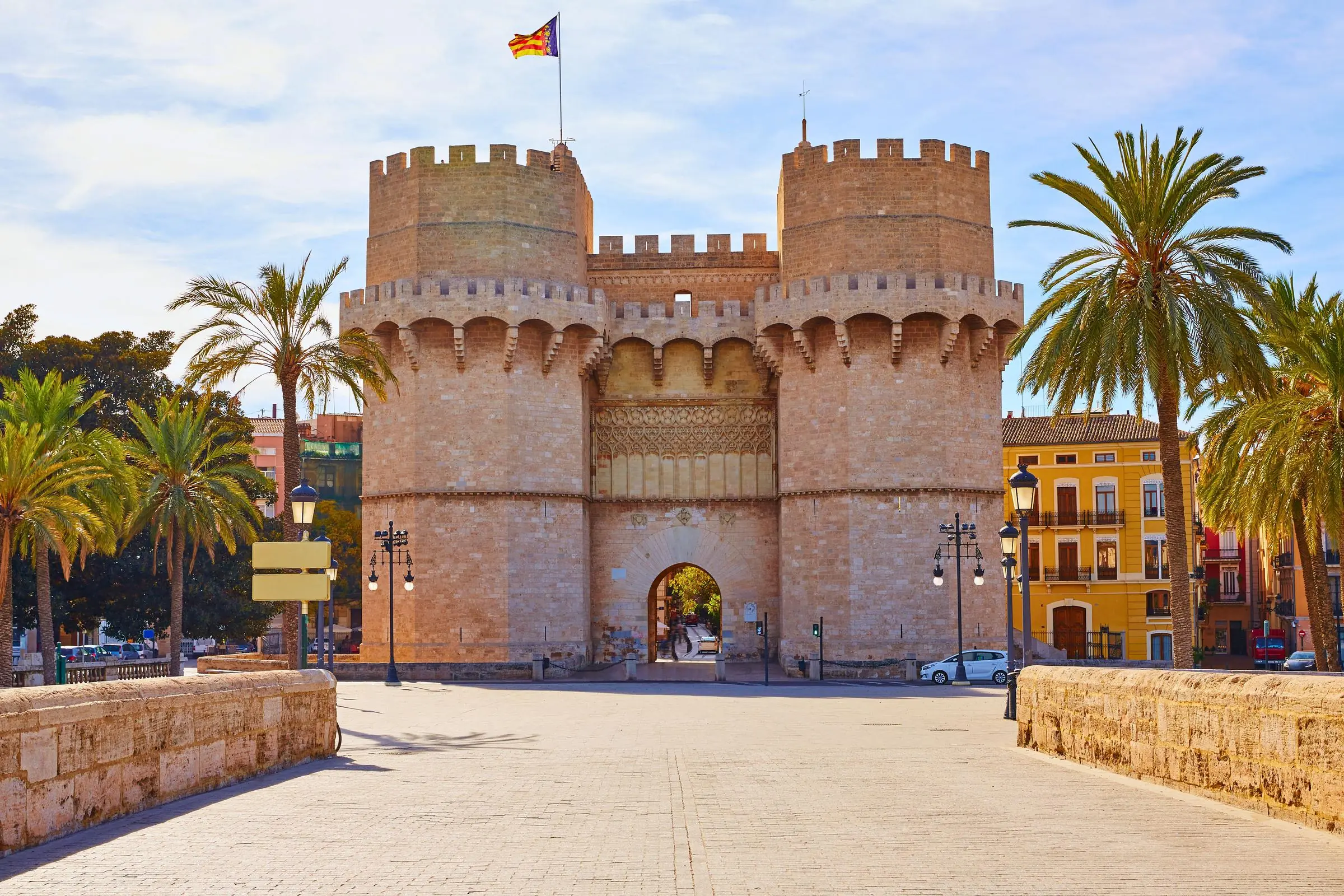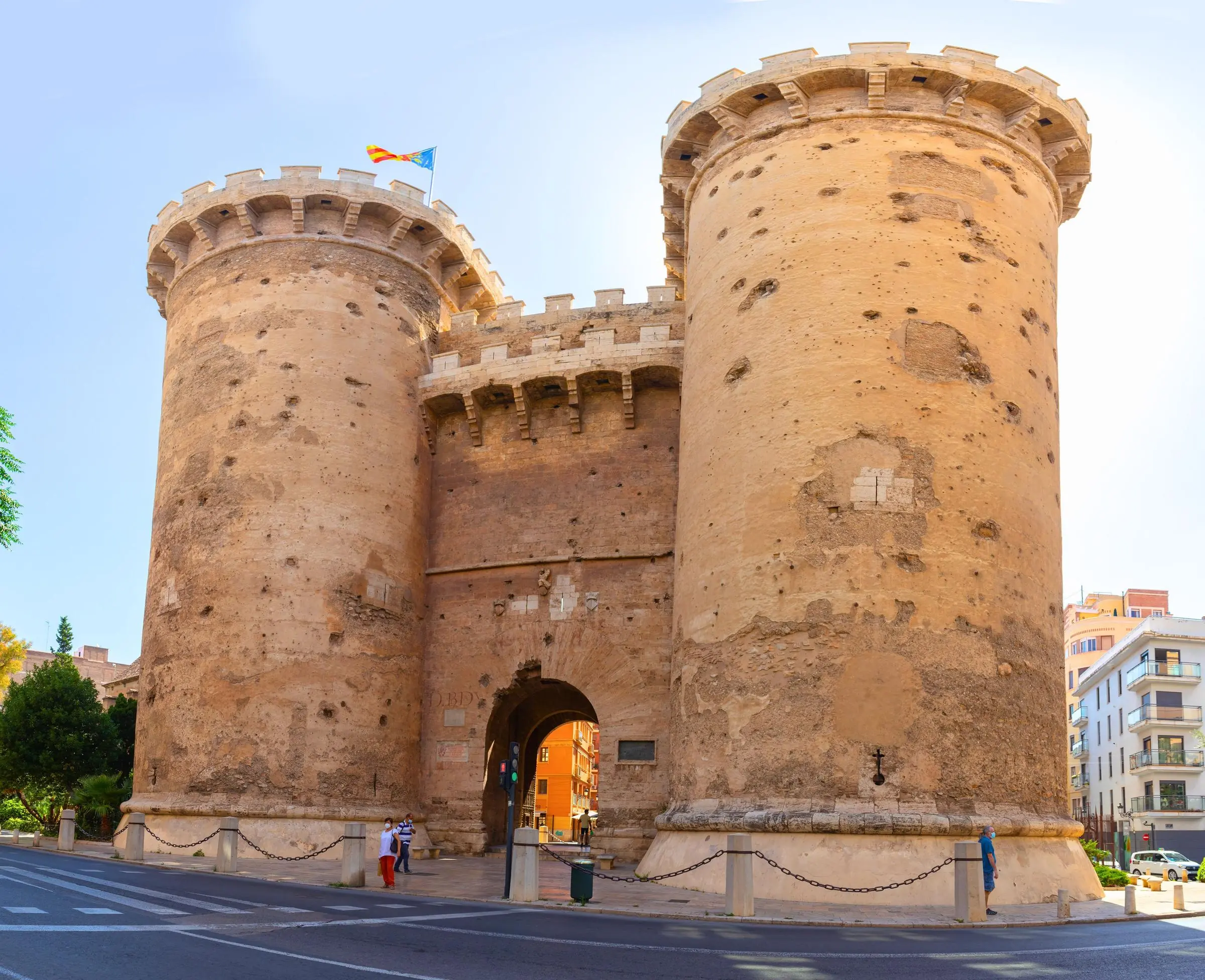
Standing at the western edge of Valencia’s historic center, the Torres de Quart (Quart Towers) are a blunt, imposing reminder of the city’s medieval past. Built between 1441 and 1460 by architect Pere Bonfill, these twin cylindrical towers formed a critical defensive gate in the old Christian city wall, facing the road that led toward Madrid.
Unlike the highly ornate Serranos Towers, the Quart Towers were built for war. Their stripped-back, late-Gothic design prioritizes sheer mass over decoration. Today, they are one of only two surviving gates from the medieval wall, offering visitors a tactile history lesson and excellent views over the Ciutat Vella.
This guide covers exactly what to look for when you visit, how to navigate the steep interior, and the best ways to combine your entry with other municipal monuments.
Is This Attraction Right For You?
The towers are a quick, inexpensive stop, but the physical layout isn’t suited for everyone.
- For the Time-Poor: You only need 30 to 45 minutes to climb the towers, take in the view, and descend. If you don’t have time to go inside, you can see the most impressive feature—the cannonball craters—from the street level at Plaza de Santa Úrsula for free.
- For Budget Travelers: Standard entry is just €2, making it one of the cheapest historical sites in the city. Better yet, entry is completely free on Sundays and public holidays. It is also included in the Valencia Tourist Card.
- For Families with Young Children: Kids generally love exploring the “castle” battlements. However, the internal spiral staircases are steep, narrow, and lack continuous handrails. You will need to keep a close grip on toddlers.
- For Visitors with Mobility Issues: There is no elevator. Access to the upper levels requires climbing dozens of uneven stone steps. If stairs are an issue, stick to viewing the exterior.
5 Highlights of the Quart Towers
The Torres de Quart are relatively bare inside, having been used as a women’s prison and a military storehouse over the centuries. The real appeal lies in the architectural details and the physical scars of history.
1. The Cylindrical Masonry
When you approach the towers from the outside (facing away from the city center), notice the smooth, sheer curve of the twin cylinders. By the mid-15th century, gunpowder artillery was becoming common in European warfare. Flat, square towers were highly vulnerable to direct cannon fire. Pere Bonfill designed the Quart Towers as cylinders to encourage cannonballs to glance off the curved ashlar stone. The walls here are incredibly thick, built with a dense core of rubble and lime mortar.
2. The 1808 Cannonball Craters
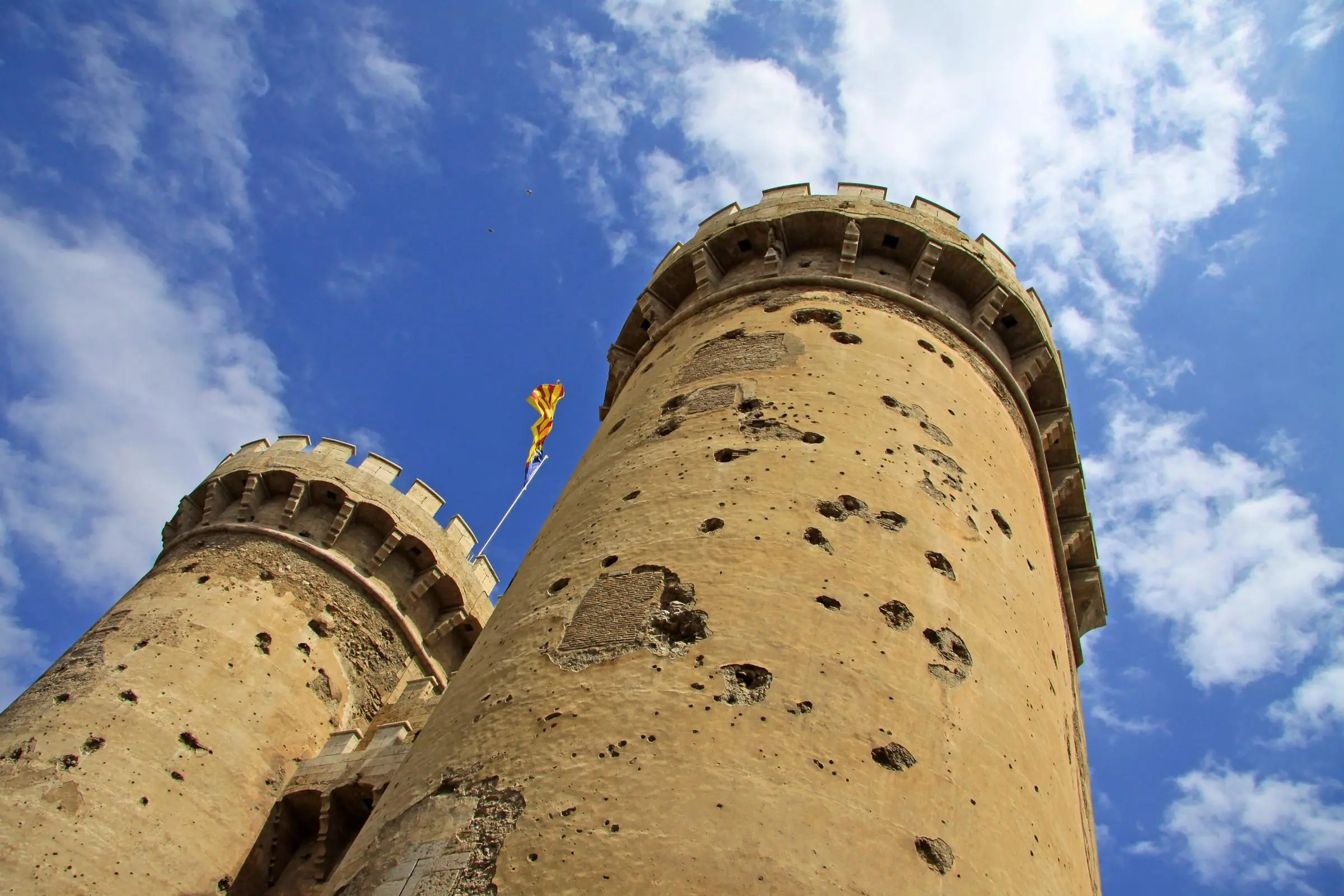
The towers’ defensive design was put to the ultimate test during the Peninsular War. In the summer of 1808, French troops under Marshal Moncey laid siege to Valencia. The Torres de Quart took the brunt of the French artillery bombardment.
If you stand in Plaza de Santa Úrsula and look up at the western face of the towers, you will see dozens of deep, jagged craters pockmarking the stone. The city deliberately left these scars unrepaired as a monument to the Valencians who defended the gate. (You can also spot smaller bullet holes clustered around the lower sections).
3. The Internal Spiral Stairs
Entering the towers from the city side (which is completely open, a design choice meant to prevent the towers from being used against the city if captured), you will ascend via steep spiral staircases. These stone steps are narrow and winding. Take your time, especially when descending, as the stone is worn smooth from centuries of foot traffic.
4. The Rooftop Battlements
The climb is worth it for the view from the crenellated roof. From the top battlements, you get a clear line of sight over the labyrinthine streets of the El Carmen neighborhood. You can spot the blue-tiled dome of the Pio V Fine Arts Museum in the distance, and trace the green ribbon of the Turia Gardens just a few blocks north.
5. The Ancient Doors
Before you leave, inspect the massive wooden doors at the base of the archway. These are heavily reinforced with iron and bronze studs. In medieval times, a curfew bell would ring at dusk. Anyone who didn’t make it inside before these doors swung shut was forced to sleep outside the city walls—a situation that gave rise to the Spanish phrase “quedarse a la luna de Valencia” (to be left to the moon of Valencia), meaning to be left out in the cold or miss an opportunity.
Quart Towers vs. Serranos Towers
Valencia has two surviving medieval gates. If you only have time for one, which should you choose?
Which towers should you visit?
Torres de Quart
- Rugged, military aesthetic with visible battle damage.
- Generally less crowded than Serranos.
- Cylindrical design feels more like a fortress.
Torres de Serranos
- Highly ornate, ceremonial Gothic architecture.
- Better views directly over the Turia Gardens.
- Often busier, as it sits on a major tourist thoroughfare.
The Verdict: If you love military history and want to see actual battle scars, choose Quart. If you prefer ornate architecture and slightly better park views, choose Serranos. Since both are cheap (or free with a pass) and only a 15-minute walk apart, it is very easy to do both.
Keep Planning: Want to see more of Valencia’s medieval architecture? Read our guide to La Lonja de la Seda, the city’s UNESCO World Heritage site.
Tickets, Logistics, and Tours
The Torres de Quart are a municipal monument. The entry fee is nominal, but there are a few ways to bundle your visit to save money and time.
Ticket Options
Valencia Tourist Card (24/48/72 Hours)
- Free entry to Torres de Quart and Torres de Serranos.
- Free entry to La Lonja and the Fallas Museum.
- Unlimited public transport (including airport metro).
Medieval Valencia Walking Tour
- 2-hour guided walk through the Ciutat Vella.
- Explains the history of the old city walls.
- Note: Usually views the towers from the outside; entry is separate.
If you are not buying a tourist card, you can simply walk up and buy a single entry ticket at the desk on the ground floor for €2.
Like all municipal museums and monuments in Valencia, the Torres de Quart are completely free to enter on Sundays and public holidays. Just walk up to the desk and they will hand you a free ticket.
How to Get There
- Address: Plaça de Santa Úrsula, 1, Ciutat Vella, 46003 València.
- Walking: The towers are a 10-minute walk west from the Central Market.
- Bus: EMT bus lines 73, C1, and 27 drop you very close to the towers.
- Metro: The closest metro stations are Turia (Line 1, 2) and Àngel Guimerà (Lines 1, 2, 3, 5, 9), both about a 10-minute walk away.
A Quick El Carmen Itinerary
Because the Quart Towers only take about 30 minutes to visit, they make a perfect starting point for a walking tour of the El Carmen neighborhood.
Afternoon in El Carmen
⏱️ Total: 3 hClimb the Quart Towers
Start your afternoon by climbing the towers. Take photos of the cannonball craters from the plaza before heading up to the roof for views over the old city.
Wander Calle Quart
Walk east down Calle Quart into the heart of the Ciutat Vella. This street is lined with historic buildings and small local boutiques.
Visit the Church of San Nicolás
Take a short detour to the Church of San Nicolás, known as the “Valencian Sistine Chapel” for its incredible frescoes. You can book entry tickets here.
Tapas in Plaza del Tossal
End your walk at Plaza del Tossal, a lively square packed with cafes and bars. Grab a table, order some patatas bravas and an Agua de Valencia, and watch the neighborhood come alive.
Where to Stay Nearby
Staying near the Torres de Quart puts you right on the edge of the historic center, making it easy to walk to major sights while remaining close to the Turia Gardens and public transit links.
FAQ
Are there elevators in the Torres de Quart?
No. The only way to access the upper levels and the roof is via steep, narrow stone spiral staircases. The monument is not wheelchair accessible beyond the ground floor.
How long does it take to visit the Quart Towers?
Most visitors spend between 30 and 45 minutes here. This gives you enough time to climb to the top, take photos, and carefully walk back down.
Are the cannonballs still lodged in the walls?
No, the actual cannonballs from the 1808 siege are no longer in the walls. What you see are the deep impact craters and structural damage left behind by the artillery fire.
Can you walk along the old city walls from the towers?
No. The medieval walls that once connected the Quart Towers to the rest of the city’s defenses were demolished in 1865 to allow the city to expand. Only the towers themselves remain.
Is entry included in the Valencia Tourist Card?
Yes. Because the Torres de Quart are a municipal monument, entry is 100% free if you show a valid 24, 48, or 72-hour Valencia Tourist Card.
When is the best time of day to take photos?
Late afternoon is best. The main facade with the cannonball craters faces west, so it is beautifully illuminated by the setting sun, highlighting the texture of the damaged stone.