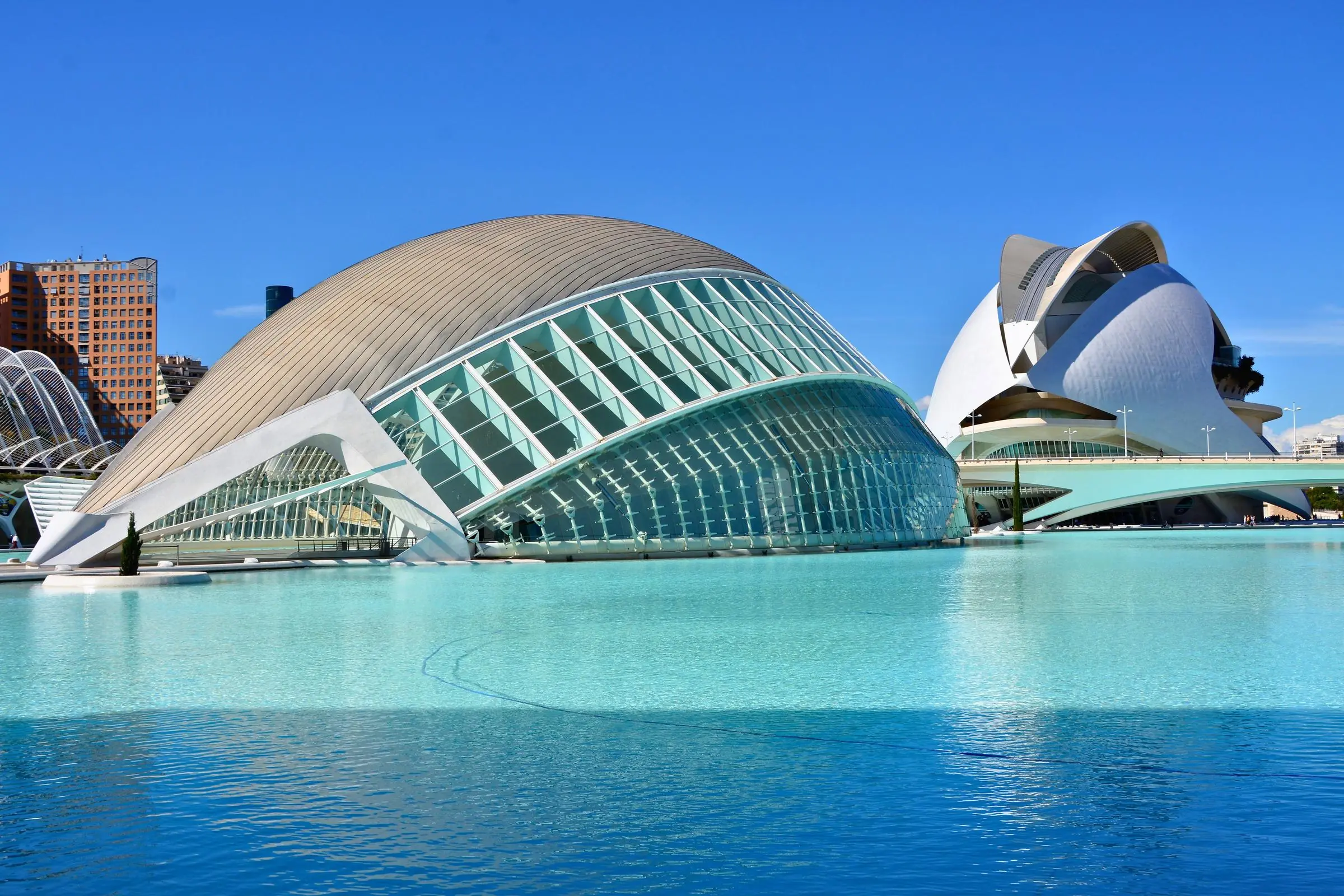
The Hemisfèric is the centerpiece of Valencia’s City of Arts and Sciences. Designed by local architect Santiago Calatrava and opened in 1998, it was the first building completed in the massive futuristic complex.
While its exterior is one of the most photographed landmarks in Spain, many visitors arrive without knowing what actually happens inside. The Hemisfèric is not a walk-through museum; it is a massive audiovisual space housing an IMAX cinema, a 3D digital planetarium, and a laser projection system.
This guide breaks down the engineering behind the building, exactly what you will experience inside, and how to navigate the somewhat confusing ticketing system if you plan to visit the neighboring Oceanogràfic or Science Museum.
Your entry ticket to the Hemisfèric is tied to a specific movie screening or planetarium show. During summer and school holidays, English-language headsets and popular afternoon slots sell out.
The Architecture: Calatrava’s “Eye of Wisdom”
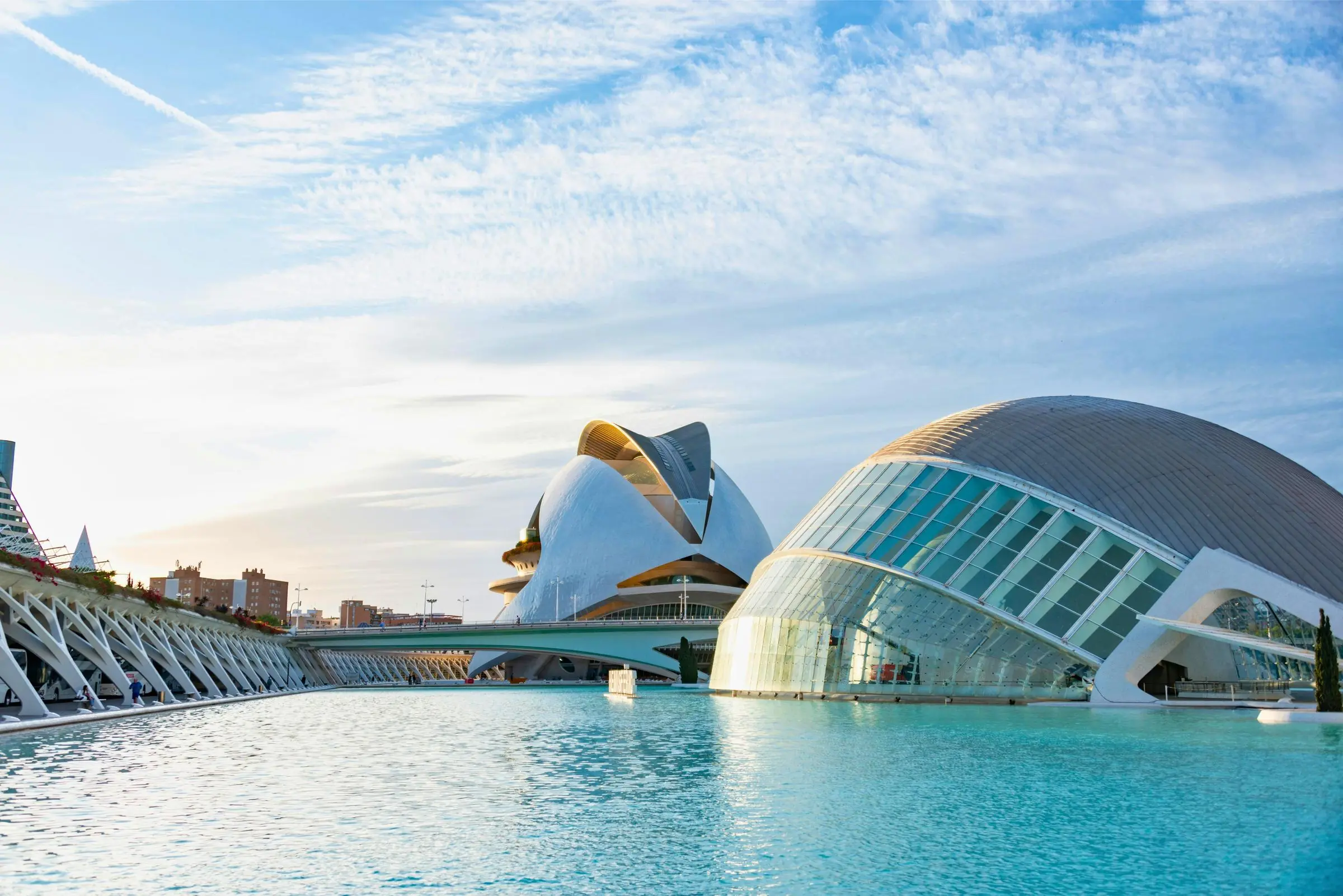
Before you step inside, it helps to understand the building you are looking at. The Hemisfèric is designed to resemble a giant human eye, symbolizing the observation of the world and the pursuit of knowledge.
The Hydraulic Roof Engineering
The “eyeball” itself is the central dome that houses the projection theater. Surrounding this dome is a massive structure of glass and steel that acts as the eyelids.
These eyelids are not static. They are made of aluminum brise-soleil (sun-shading) slats mounted on a complex hydraulic system. When the hydraulic lifts engage, the massive gates fold upward, effectively “opening” the eye to the sky. While the roof is rarely opened fully during standard operating hours (to control the climate inside the theater), you can often see the slats adjusting to regulate sunlight hitting the inner glass concourse.
The Perimeter Reflecting Pools
The optical illusion of the eye relies entirely on the 24,000-square-meter reflecting pool surrounding the building. The physical structure forms the top half of the eye, while the still water reflects it perfectly to create a complete oval.
Local Tip: The best place to photograph the complete “eye” is from the southern edge of the pool, near the Umbracle gardens, early in the morning before the wind picks up and ripples the water.
5 Experience Highlights Inside
If you purchase a Hemisfèric entry ticket, you are buying access to a 45-to-50-minute screening. Here is what the facility actually houses.
1. The 100-Meter Concave IMAX Screen
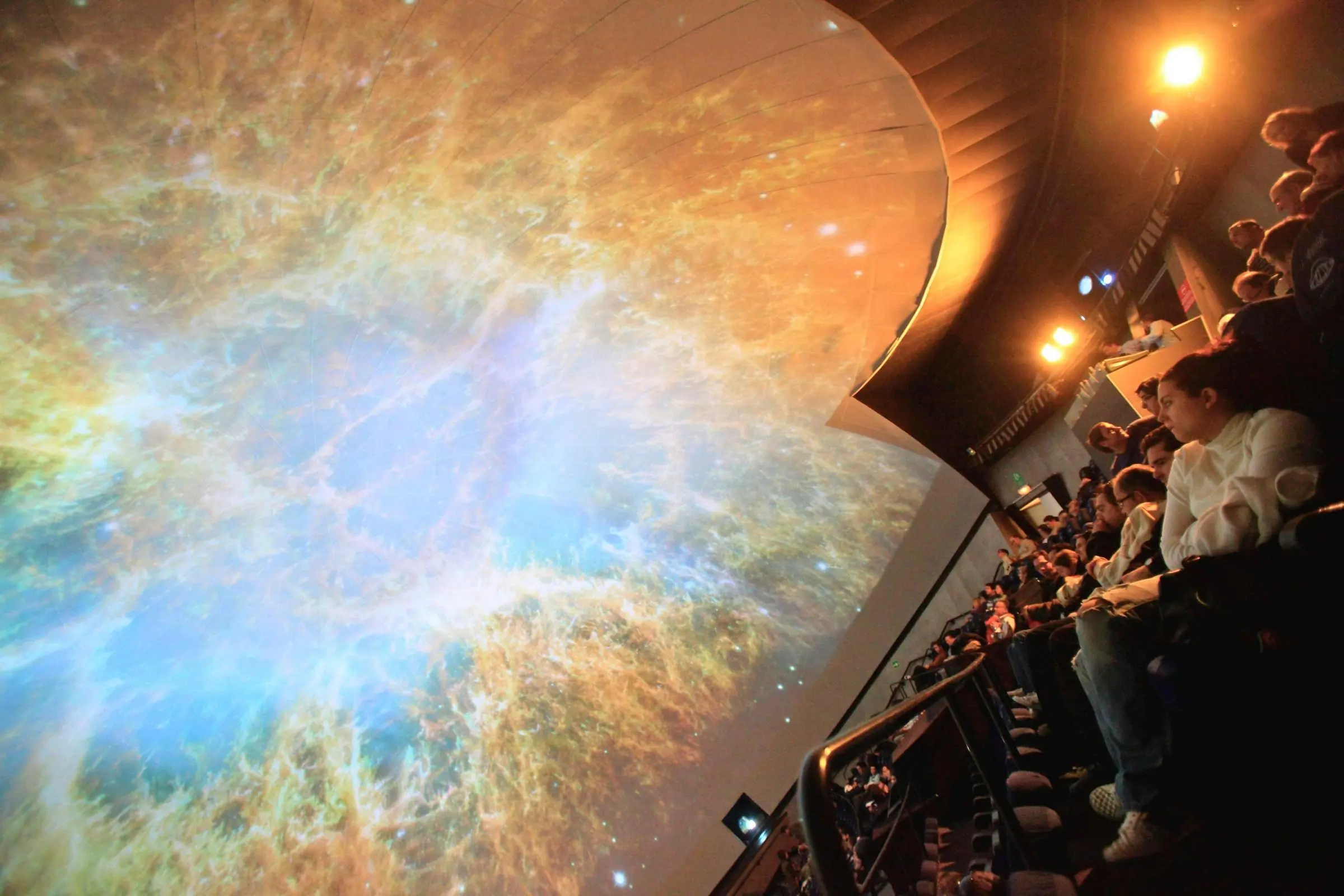
The main attraction is the IMAX Dome (Omnimax) projection system. Unlike a standard cinema, the screen here is a massive 900-square-meter concave dome that wraps around your peripheral vision. The films are typically nature documentaries (dinosaurs, deep sea exploration, space) designed to make you feel like you are moving through the environment.
2. 3D Digital Planetarium Shows
The same dome is used for astronomical planetarium shows. Using high-definition digital projectors, the ceiling transforms into a map of the known universe. These shows are less about narrative storytelling and more about immersive, educational journeys through the solar system and beyond. Check the daily schedule, as planetarium shows alternate with standard IMAX documentaries.
3. The Carl Sagan Auditorium
The theater space itself is officially named the Carl Sagan Auditorium. It seats roughly 300 people on a steep incline. The seating is designed so that you recline heavily, looking almost straight up at the dome.
4. Laser Projection Tech
For specific evening events and specialized shows, the Hemisfèric utilizes a state-of-the-art laser projection system. This allows for incredibly crisp, high-contrast imagery to be mapped directly onto the dome, often used for abstract art visualizations or special astronomical events.
5. The Glass Concourse
Before your movie starts, you will wait in the outer ring of the building. This curved, glass-enclosed concourse wraps around the central dome. It features a small café, restrooms, and a few minor scientific exhibits. It’s a striking space to stand in, as you can see the hydraulic struts of the roof up close and look out over the blue pools.
The Headset System: Because the films are projected in multiple languages simultaneously, the theater audio is not played through external speakers. Instead, you are handed an infrared headset at the door. You can toggle a switch on the headset to select English, Spanish, Valencian, or French. Make sure your headset has working batteries before the lights go down.
Tickets: Single Entry vs. Combos
Ticketing for the City of Arts and Sciences can be confusing because the buildings are managed by the same entity, but you can buy access to them a la carte or bundled.
If you just want to see a movie, a standalone Hemisfèric ticket costs around €9. However, if you plan to visit the aquarium or the science museum, buying an Oceanogràfic and Hemisfèric combo ticket is significantly cheaper than buying them separately.
Hemisfèric Single Ticket
- Access to one IMAX or Planetarium show
- Infrared headset included
- Best if you only have 1 hour
Oceanogràfic + Hemisfèric
- Full day access to the aquarium
- One movie screening at Hemisfèric
- Saves roughly €7 compared to separate tickets
- Valid for 1 or 2 consecutive days
All Three Attractions
- Oceanogràfic + Science Museum + Hemisfèric
- Can be split across 2 or 3 days
- Ideal for families with a long weekend
Keep Planning: If you are trying to decide which attractions to bundle, read our deep-dive on the Oceanogràfic and our breakdown of the Science Museum.
Seating Tips & Inside Logistics
Watching a movie on a 900-square-meter dome is a different physical experience than a normal cinema. If you sit in the wrong spot, you will leave with a stiff neck.
- Where to Sit: The seats are not assigned; it is open seating. You want to sit in the middle rows (Rows 5, 6, or 7) and as close to the dead center as possible.
- Where NOT to Sit: Avoid the front three rows at all costs. The screen curves heavily over the front, forcing you to crane your neck backward for 45 minutes. Also, avoid the extreme left or right edges, as the image will distort.
- Arrive Early: Because seating is first-come, first-served, queue up at the auditorium doors about 15 minutes before your showtime.
- Temperature: The auditorium is heavily air-conditioned to protect the projection equipment. If you are visiting in the peak of summer wearing a tank top and shorts, you might actually get chilly. Bring a light layer.
Advice for Different Traveler Types
For Families with Kids: The Hemisfèric is a fantastic mid-afternoon pit stop. If you have spent the morning walking around the City of Arts and Sciences in the heat, an IMAX movie provides 45 minutes of dark, air-conditioned rest while keeping the kids entertained. Choose a dinosaur or space documentary over the more abstract planetarium shows.
For the Time-Poor: If you only have a weekend in Valencia, skip the movie. The documentaries are standard IMAX fare that you can see in any major city. Instead, spend your time admiring the architecture from the outside, taking photos of the reflecting pools, and dedicating your actual entry time to the Oceanogràfic or exploring the historic center.
For Budget Travelers: You do not need a ticket to walk around the building. The entire perimeter of the reflecting pools is public space. You can walk right up to the glass, walk under the massive concrete arches, and get stunning photos completely for free.
Getting There & Around
The Hemisfèric is located in the dry Turia riverbed, right in the middle of the City of Arts and Sciences complex.
- By Bus: EMT Bus lines 13, 15, 19, 24, 25, 35, 40, 95, and 99 all stop near the complex. Bus 95 is the most useful for tourists, as it runs the entire length of the Turia Gardens.
- By Metro: Take Metro Line 10 (the tram line) and get off at the Ciutat Arts i Ciències - Justícia stop. It is a 5-minute walk to the Hemisfèric from there.
- By Bike: The complex is highly bike-friendly. There are wide, flat paths leading directly from the historic center through the Turia park to the Hemisfèric.
- Parking: There is a massive underground parking garage located directly beneath the Umbracle (the arched garden next to the Hemisfèric). If you buy any entry ticket to the complex, you can usually get a flat-rate parking discount for the day at the ticket counters.
Where to Stay Nearby
Staying near the Hemisfèric puts you in the modern part of the city, halfway between the historic center and Malvarrosa beach. The immediate area (Quatre Carreres and Penya-Roja) is filled with modern hotels, wide avenues, and easy access to the Turia Gardens.
FAQ
How long does a visit to the Hemisfèric take?
The movies and planetarium shows last between 45 and 50 minutes. Factor in 15 minutes to queue and get your headset, making the total experience about 1 hour and 15 minutes.
Are the movies in English?
Yes. The audio is delivered via infrared headsets provided at the door. You can switch the channel on your headset to listen to the narration in English, Spanish, Valencian, or French.
Can I just go inside to look at the architecture without a ticket?
You can walk up to the glass doors and look into the outer concourse, but you cannot pass the turnstiles into the building’s ring or the auditorium without a valid ticket for a specific showtime.
Is the Hemisfèric wheelchair accessible?
Yes. The building is fully accessible, with ramps leading down to the entrance and designated wheelchair spaces at the top of the Carl Sagan Auditorium for optimal viewing.
Does the roof actually open?
The glass and steel “eyelids” do open and close via hydraulic lifts, but this is usually done for maintenance, ventilation, or special events, not during standard movie screenings. The inner projection dome remains closed.
Which is better: the IMAX movie or the Planetarium show?
It depends on your preference. The IMAX documentaries (usually nature or space exploration) are highly immersive and great for kids. The Planetarium shows are more educational and abstract, focusing on constellations and astronomy.