The Museum of Illusions is part of a massive global franchise, but that doesn’t make it any less effective at what it does: tricking your brain and filling your camera roll. Located right in the heart of Valencia, this venue is essentially a playground of visual trickery, forced perspective, and interactive puzzles.
Unlike traditional museums where you stand behind a velvet rope and read placards, this space requires you to touch, climb, and pose. If you don’t participate, the illusions simply don’t work. Because it is highly visual and heavily reliant on taking photos, it can get chaotic during peak hours. This guide breaks down exactly how to navigate the space, which installations are worth your time, and how to get the best out of your visit without losing your patience in a room full of mirrors.
Keep in mind: This is not a massive, all-day attraction. Most visitors spend about 45 to 60 minutes inside. It is best paired with a walking tour of the nearby historic center or a lunch stop in the Ciutat Vella.
Is the Museum of Illusions Right for You?
Before you book your entry tickets, it helps to know if this attraction fits your travel style. It is highly specific in its appeal.
Who should visit (and who should skip it)
Great for Kids and Teens
- Why it works: Kids love the tactile nature of the puzzles, and teenagers will appreciate the highly shareable photo opportunities. It’s a reliable, weather-proof option if you need a break from historical walking tours.
Fun for a Quick Stop
- Why it works: It’s a lighthearted, low-stakes activity. If you enjoy taking creative photos of each other, you’ll get your money’s worth. If you hate posing for the camera, you will likely be bored in 15 minutes.
Skip It
- Why it works: Almost every major illusion requires a second person to take the photo from a specific vantage point. While the staff is sometimes available to help, visiting alone defeats the purpose of most installations.
Deep-Dive: The 5 Core Installations
The museum features dozens of smaller holograms and wall-mounted optical illusions, but the main draw is the large-scale, immersive rooms. Here is what to expect from the heavy hitters.
1. The Vortex Tunnel
This is usually the most talked-about installation, and for good reason. You walk across a perfectly stable, flat metal bridge while a massive, illuminated cylinder spins rapidly around you.
Your brain relies on visual cues to maintain balance. When the walls spin, your brain tells your body that you are spinning, causing an immediate and intense feeling of vertigo. Most people instinctively grab the handrails and lean heavily to one side.
- The Reality: It is genuinely disorienting. If you suffer from severe motion sickness, vertigo, or epilepsy, you should bypass this tunnel entirely. There is a clear path to walk around it.
- Photo Tip: Video works much better here than still photography. Record your friends trying to walk in a straight line.

2. The Anti-Gravity Room
This room plays with your sense of verticality. The floor is built on a steep slant, but the walls, furniture, and props are angled to make the room look perfectly level. When you stand inside, you appear to be leaning at an impossible, Michael Jackson-esque angle.
- The Reality: Walking around the room feels bizarre because your inner ear disagrees with your eyes. It can get crowded, so you may have to wait your turn to get a clean shot without strangers in the background.
- Photo Tip: The illusion only works if the camera is held perfectly parallel to the room’s “fake” horizon line. There are usually markers on the floor outside the room showing the photographer exactly where to stand and how to tilt the camera.
3. The Infinity Room
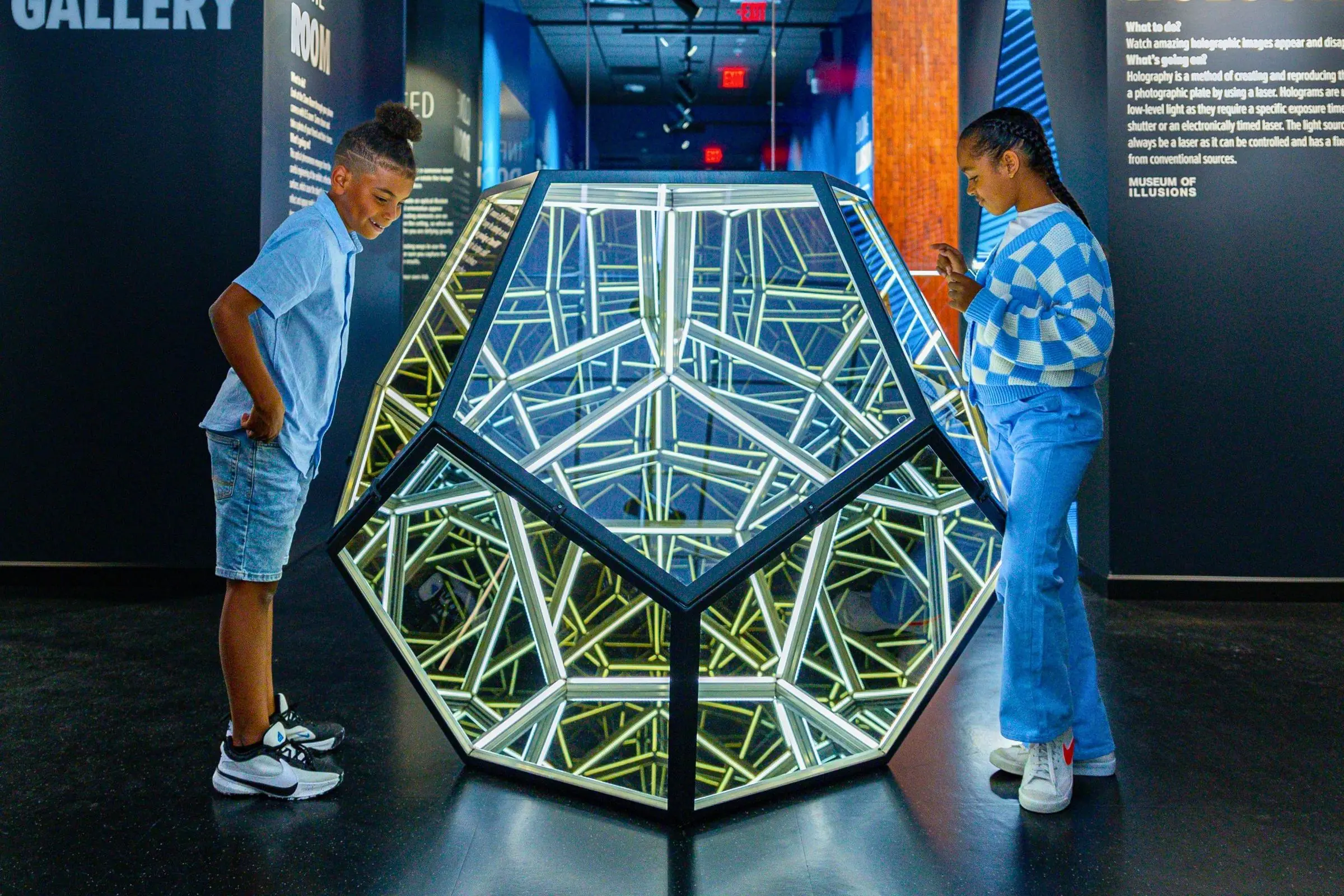
A staple of modern interactive museums, the Infinity Room is a small, enclosed space completely lined with mirrors. Combined with carefully placed LED lights, the reflections bounce back and forth endlessly, creating the illusion of infinite space.
- The Reality: The room is quite small. To keep the line moving, staff usually limit groups to about 60 seconds inside.
- Photo Tip: Wear bright colors to stand out against the reflections. Avoid using a flash, as it will bounce off the mirrors and ruin the exposure.
4. The Ames Room
Invented by ophthalmologist Adelbert Ames Jr. in 1946, this is a distorted room that creates an optical illusion of relative size. The room is actually a trapezoid, but viewed from a specific peephole (or camera lens), it looks like a normal rectangular room. If two people stand in opposite corners, one looks like a giant and the other like a miniature person.
- The Reality: This is the most popular photo op in the museum. You will have to wait in line.
- Photo Tip: Have the taller person stand in the “small” corner and the shorter person in the “giant” corner to exaggerate the effect. The photographer must shoot through the designated viewing hole, or the forced perspective breaks entirely.
5. Hologram Galleries
Scattered throughout the hallways between the main rooms are various holograms—images that change, move, or appear 3D depending on your viewing angle. You’ll see portraits that follow you with their eyes and flat surfaces that look like deep tunnels.
- The Reality: These are fun to look at but notoriously difficult to photograph.
- Photo Tip: Don’t bother trying to take pictures of the holograms. Your phone’s camera cannot capture the 3D effect properly. Just enjoy these with your eyes.
Keep Planning: Looking for more family-friendly indoor activities? Check out our guide to visiting the Science Museum in the City of Arts and Sciences.
Ticket Comparison: Museum of Illusions vs. Legacy Venues
Valencia has two main venues dedicated to illusions and interactive photography: The global Museum of Illusions and the locally themed Iluziona Museum. Here is how they stack up.
Museum of Illusions Valencia
- Focus: Classic optical illusions, physics, and brain teasers.
- Vibe: Modern, sleek, and highly standardized.
- Language: Fully bilingual (English/Spanish).
- Best for: Teens, science nerds, and Instagrammers.
Iluziona Museum
- Focus: Trompe l’œil paintings and Valencian history.
- Vibe: Quirky, slightly dated, but charming.
- Language: Mostly Spanish, though the visual gags translate easily.
- Best for: Younger kids and those wanting a Valencian theme (e.g., posing inside a giant paella).
If you want the slick, mind-bending physics rooms (like the Vortex Tunnel), stick with the Museum of Illusions. If you want a slightly cheaper, sillier experience where you pretend to hang from the Serranos Towers, Iluziona is a fun alternative.
Mobile Photography Hacks for the Museum
The entire venue is designed to be photographed, but bad lighting and incorrect angles can ruin the effect. Here is how to get the shots right on your smartphone.
- Turn on the 3x3 Grid: Go to your phone’s camera settings and enable the grid. Many illusions (like the Anti-Gravity room) require you to align your camera with a specific line on the wall or floor. The grid makes this infinitely easier.
- Look for the Floor Stickers: The museum places vinyl stickers on the floor indicating exactly where the photographer should stand. Do not ignore these. If you step two feet to the left, the Ames Room just looks like a weirdly shaped box.
- Clean Your Lens: You will be shooting through glass, into mirrors, and under harsh LED lights. A smudged phone lens will cause massive light glare and ruin the contrast of your photos. Wipe it on your shirt before you start.
- Lock Your Focus and Exposure: In rooms with dynamic lighting (like the Infinity Room), your phone will constantly try to adjust the brightness. Tap and hold on your subject’s face on your screen to lock the focus and exposure, then drag the sun icon down slightly to darken the room and make the colors pop.
- Use the Ultra-Wide Lens Sparingly: While it’s tempting to use the 0.5x lens to capture the whole room, ultra-wide lenses distort the edges of the frame. This distortion can actually break the forced perspective of the illusions. Stick to the standard 1x lens unless absolutely necessary.

Logistics: Getting There and Avoiding Crowds
The Museum of Illusions is located at Carrer de Sant Vicent Màrtir, 51, right in the bustling commercial center of Valencia, just a few minutes’ walk from the Central Market and Plaza del Ayuntamiento.
When to Visit
Because the museum is small and relies on taking turns at photo stations, crowds severely impact the experience.
- Worst time: Weekends between 11:00 AM and 2:00 PM, and rainy days (when everyone abandons the beach for indoor activities).
- Best time: Weekday mornings right when they open, or late evenings (they are usually open until 9:00 PM or 10:00 PM depending on the season).
The museum operates on timed-entry slots to prevent overcrowding. If you show up on a Saturday afternoon without a ticket, you will likely be turned away or told to come back three hours later.
How to Get There
- By Metro: Take Line 3, 5, or 9 to Xàtiva station. The museum is a 5-minute walk from the station, heading north toward Plaza de la Reina.
- By Bus: EMT lines 7, 27, and 73 drop you very close to the venue.
- Walking: If you are exploring the Ciutat Vella, you will likely walk right past it. It is highly central.
Where to Stay Nearby
If you want to be in the thick of the action, staying near the museum puts you within walking distance of the Cathedral, the Central Market, and dozens of great restaurants. Use the map below to find hotels and apartments in the immediate vicinity.
Frequently Asked Questions
How long does it take to go through the Museum of Illusions Valencia?
Most visitors spend between 45 minutes and 1 hour inside. If the museum is crowded and you have to wait in line for the popular photo rooms (like the Ames Room or the Infinity Room), it might take up to 75 minutes.
Is the Museum of Illusions wheelchair accessible?
Yes, the ground floor and the main installations are accessible for wheelchair users. However, a few specific installations (like the Vortex Tunnel) require walking across a narrow bridge and are not suitable for wheelchairs or strollers.
Do I need to print my tickets?
No, digital tickets on your smartphone are perfectly fine. Just have the barcode ready when you approach the entrance.
Can I bring a stroller inside?
Strollers are allowed, but the museum can get quite cramped. If your child is old enough to walk, or if you have a baby carrier, it is highly recommended to leave the stroller at your hotel or fold it up, as navigating the tight corners with a pram can be frustrating.
Is the Museum of Illusions included in the Valencia Tourist Card?
No, the Museum of Illusions is a private attraction and is not included in the standard Valencia Tourist Card. You must purchase a separate entry ticket.
Are there lockers available for bags?
The museum does not have large luggage lockers, but they do have a small cloakroom area where you can leave coats and small bags. Do not bring large suitcases to the venue. If you need to store luggage, check out our guide to luggage storage in Valencia.
For more official information on visiting Valencia, you can check the Visit Valencia Tourism Board.